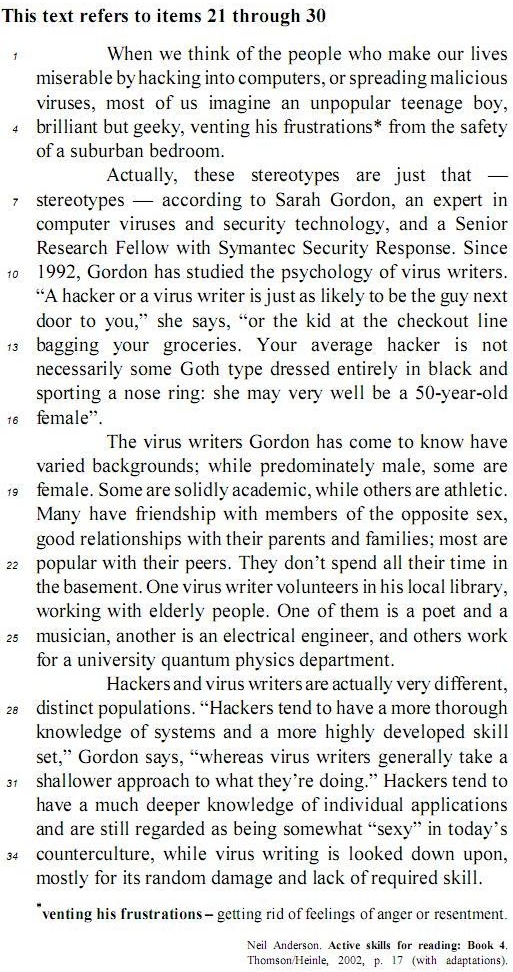
Based on the text above, judge the following items.
In the text,
“parents” ( .21) refers to mother and father.
In the text,
“parents” (
.21) refers to mother and father..21) refers to mother and father.Based on the preceding text, judge the item that follow.
The passenger who sued the airline company because of an incident that happened during his flight is Colombian.
The Indian education sector has undergone a significant transformation in recent years, owing to the implementation of innovative technologies and solutions. According to a recent report, the e-learning market in India is estimated to have reached $ 1.96 billion in 2021, up from $ 247 million in 2016. The growth in popularity of mobile learning platforms among students has led to this expansion.
Mobile learning platforms are expected to play a significant role in the growth of the online education market in India. A report by a consultancy company projected that the online education market in India would reach $ 1.96 billion by 2021. Educational apps have seen tremendous success by offering interactive video lessons, quizzes, and personalized learning plans to help students succeed academically.
Personalized learning, tailoring teaching and learning to students’ needs, is also an important trend in the Indian education sector. In addition to technology, the Indian education sector has also witnessed the emergence of new pedagogical approaches such as experiential learning, project-based learning, and collaborative learning. These approaches focus on providing students with hands-on, practical learning experiences that prepare them for the real world.
With the continued adoption of these technologies and approaches, the future of education in India looks bright, offering students new opportunities to learn and grow.
Internet: <https://varthana.com/school> (adapted).
Based on the preceding text, judge the following item.
The word “education” (first sentence of the text) is a noun,
being nouns words that can work as the subject of a
sentence, and can refer to a person, a place, a thing, or an
idea.
Suas atualizações recentes
Nenhuma notificação.