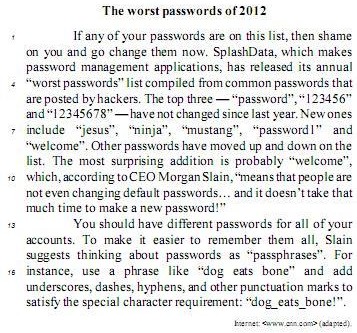
Based on the text above, judge the following items.
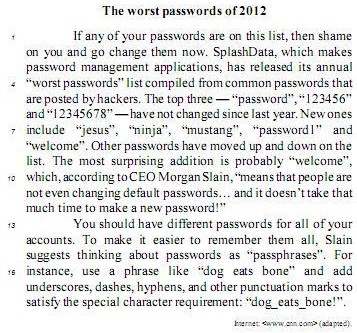
The article criticizes the reader who uses any of the passwords listed on the compilation prepared by SplashData.
Based on the text above, judge the following items.
The article criticizes the reader who uses any of the passwords listed on the compilation prepared by SplashData.
It has become clear that preventive diplomacy is only one
of a class of actions that can be taken to prevent disputes from
turning into armed conflict. Others in this class are preventive
deployment of military and(or) police personnel; preventive
humanitarian action, for example, to manage and resolve a
refugee situation in a sensitive frontier area; and preventive
peace-building, which itself comprises an extensive menu of
possible actions in the political, economic and social fields,
applicable especially to possible internal conflicts.
All these preventive actions share the following
characteristics: they all depend on early warning that the risk of
conflict exists; they require information about the causes and
likely nature of the potential conflict so that the appropriate
preventive action can be identified; and they require the consent
of the party or parties within whose jurisdiction the preventive
action is to take place.
The element of timing iscrucial. The potential conflict
should be ripe for the preventive action proposed. Timing is also
an important consideration in peace-making and peace-keeping.
The prevention, control and resolution of a conflict is like the
prevention, control and cure of a disease. If treatment is
prescribed at the wrong moment in the evolution of a disease, the
patient does not improve, and the credibility of both the treatment
and the physician who prescribed it is compromised.
Internet: (with adaptations).
From text II, it can be deduced that
many problems involving refugees occur in frontier areas.

At the opening of paragraph 2, the leader of the centre-left USL, Victor Ponta, expressed his
Read the text below which is entitled “The future of work” in
order to answer questions 21 to 24.
The future of work
Source: Newsweek
Jan 30th, 2006 (Adapted)
Many of the rich world’s notions about old age are dying.
While the streamlining effects of international competition
are focusing attention on the need to create and keep good
jobs, those fears will eventually give way to worries about
the growing shortage of young workers. One unavoidable
solution: putting older people back to work, whether they
like it or not. Indeed, cutting-edge European economies
like those of Finland and Denmark have already raised
their retirement ages, reversing the postwar trend toward
ever-earlier retirement. Others are under severe pressure
to follow suit, as both the European Commission and the
Organization for Economic Cooperation and Development
(OECD) have recently warned their members that their
future prosperity depends on a growing contribution from
the elderly.
This erosion of one of the cornerstones of the good
life – relaxed golden years – has not gone unremarked. In
the last year, Belgium, Italy and France have all been hit
with massive protests against pension reforms that would,
among other things, have raised the retirement age.
Paragraph 2 of the text allows us to discover that the writer is
According to paragraph 1, Romania´s government
Read the text below which is entitled “The future of work” in
order to answer questions 21 to 24.
The future of work
Source: Newsweek
Jan 30th, 2006 (Adapted)
Many of the rich world’s notions about old age are dying.
While the streamlining effects of international competition
are focusing attention on the need to create and keep good
jobs, those fears will eventually give way to worries about
the growing shortage of young workers. One unavoidable
solution: putting older people back to work, whether they
like it or not. Indeed, cutting-edge European economies
like those of Finland and Denmark have already raised
their retirement ages, reversing the postwar trend toward
ever-earlier retirement. Others are under severe pressure
to follow suit, as both the European Commission and the
Organization for Economic Cooperation and Development
(OECD) have recently warned their members that their
future prosperity depends on a growing contribution from
the elderly.
This erosion of one of the cornerstones of the good
life – relaxed golden years – has not gone unremarked. In
the last year, Belgium, Italy and France have all been hit
with massive protests against pension reforms that would,
among other things, have raised the retirement age.
According to the text,
It has become clear that preventive diplomacy is only one
of a class of actions that can be taken to prevent disputes from
turning into armed conflict. Others in this class are preventive
deployment of military and(or) police personnel; preventive
humanitarian action, for example, to manage and resolve a
refugee situation in a sensitive frontier area; and preventive
peace-building, which itself comprises an extensive menu of
possible actions in the political, economic and social fields,
applicable especially to possible internal conflicts.
All these preventive actions share the following
characteristics: they all depend on early warning that the risk of
conflict exists; they require information about the causes and
likely nature of the potential conflict so that the appropriate
preventive action can be identified; and they require the consent
of the party or parties within whose jurisdiction the preventive
action is to take place.
The element of timing iscrucial. The potential conflict
should be ripe for the preventive action proposed. Timing is also
an important consideration in peace-making and peace-keeping.
The prevention, control and resolution of a conflict is like the
prevention, control and cure of a disease. If treatment is
prescribed at the wrong moment in the evolution of a disease, the
patient does not improve, and the credibility of both the treatment
and the physician who prescribed it is compromised.
Internet: (with adaptations).
From text II, it can be deduced that
military actions will necessarily lead to armed conflict.
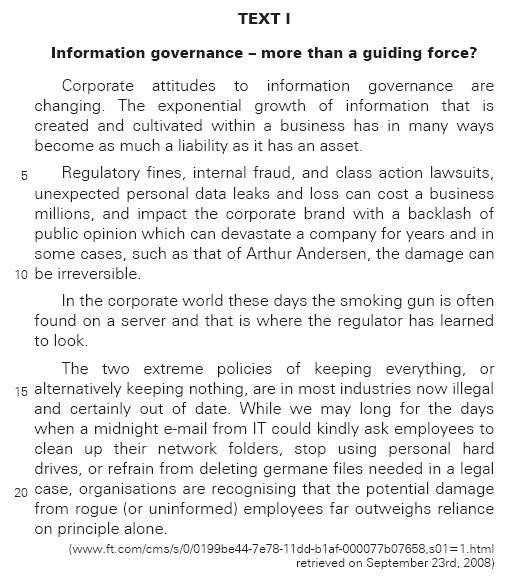
The text states that the increase of information has
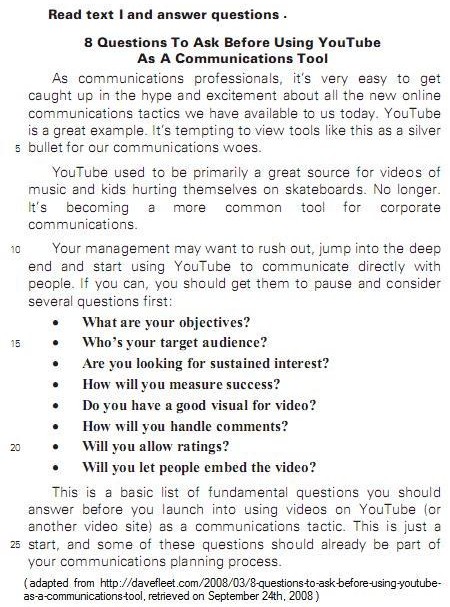
As regards YouTube, the author believes one should be
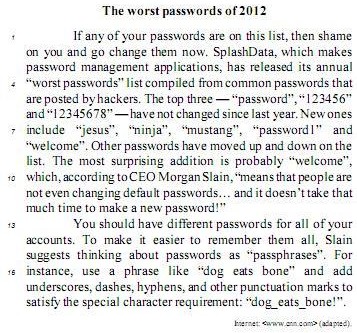
Based on the text above, judge the following items.
It can be concluded from the text that the word welcome is the default password for many services.
Green is the hot topic these days, and the concept
is having an impact on the way people think about
datacenters. Companies around the world are
announcing ways to save energy and reduce costs by
5 buying new hardware and services. Yet, there is little
guidance on how you can take action to control energy
costs. In the past, electricity has been treated as an
overhead expense, like the cost of space. But with rising
power costs and issues regarding reliability, supply, and
10 capacity, electricity requires its own specific strategy.
Projects regarding performance optimization and
cost reduction are a part of everyday best practices
The final message of the text (lines 55-66) is that:
An 18-Minute Plan for Managing Your Day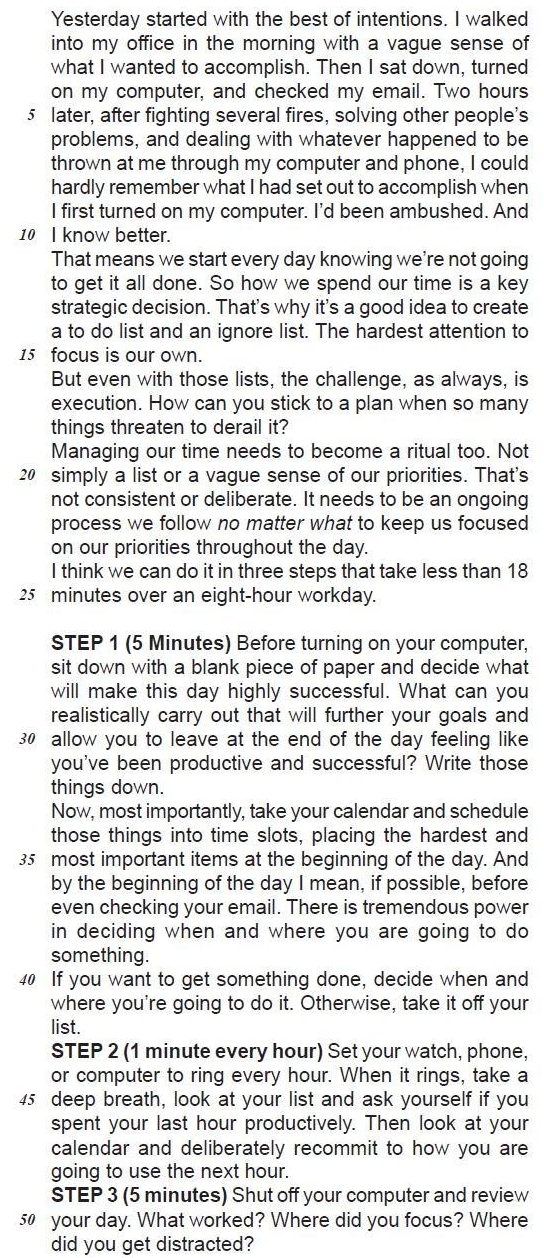
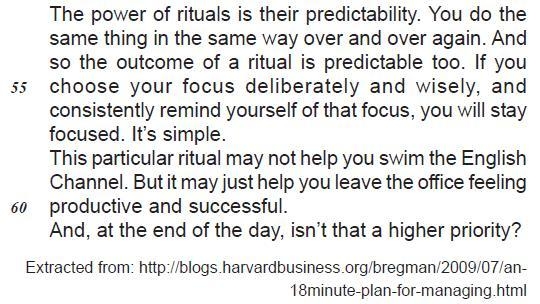
According to STEP 3,
Green is the hot topic these days, and the concept
is having an impact on the way people think about
datacenters. Companies around the world are
announcing ways to save energy and reduce costs by
5 buying new hardware and services. Yet, there is little
guidance on how you can take action to control energy
costs. In the past, electricity has been treated as an
overhead expense, like the cost of space. But with rising
power costs and issues regarding reliability, supply, and
10 capacity, electricity requires its own specific strategy.
Projects regarding performance optimization and
cost reduction are a part of everyday best practices
The title that best summarizes the content of the article is:
According to Paragraph 4, the "ideal energy source":
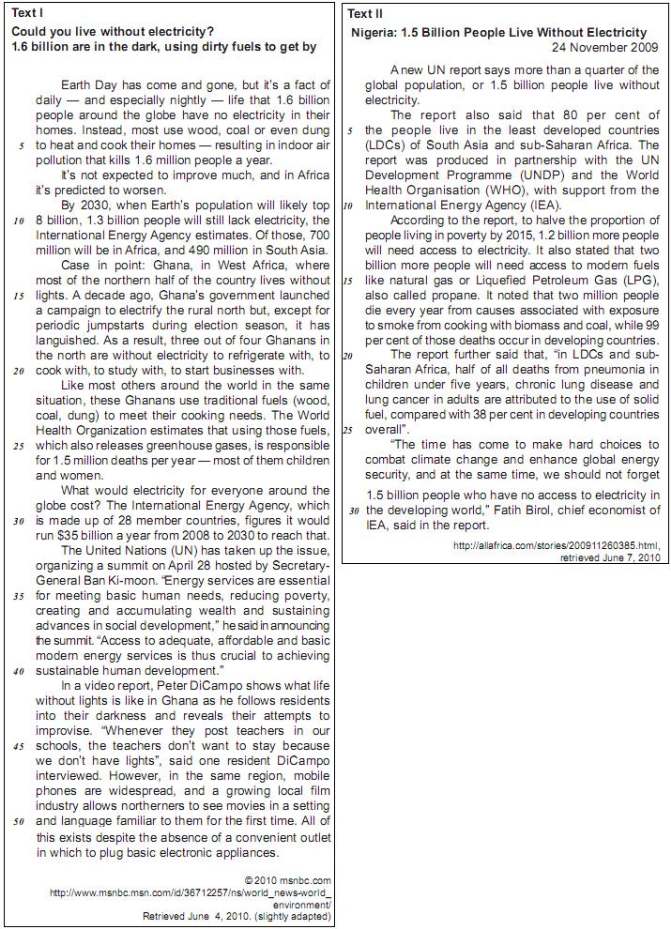
Both Text I and Text II
Read the text below which is entitled The perils of
prosperity in order to answer questions 28 to 30.
The perils of prosperity
Source: The Economist
April 27th 2006 (Adapted)
Midway through the first decade of the 21st century,
economic growth is pulling millions out of poverty. Growth,
so devoutly desired yet often so elusive for developing
countries, is occurring in China and India on a heroic scale.
Yet once affluence is achieved, its value is often questioned.
In the 1960s and 1970s, economists started worrying about
environmental and social limits to growth. Now Avner Offer,
professor of economic history at Oxford University, has
added a weighty new critique to this tradition.
The Challenge of Affluence accepts that the
populations of poor countries gain from growth, but says
that the main benefits of prosperity are achieved at quite
modest levels. Its central thesis is that rising living standards
in Britain andAmerica have engendered impatience, which
undermines well-being. The fruits of affluence are bitter
ones, and include addiction, obesity, family breakdown and
mental disorders.
Professor Offer´s new critique is described as weighty. Therefore,
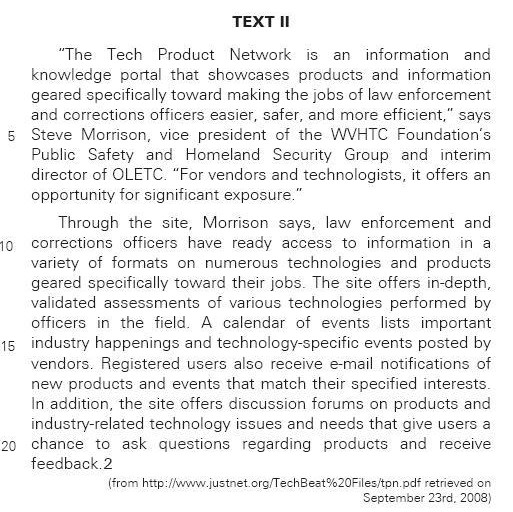
The expression that could replace "geared toward" in "geared specifically toward their jobs" (line 12) is
Based on the text above, judge the following items.
The sentence You should have different passwords for all of your accounts (L.13-14) expresses an advice to the reader.
Atenção: Considere o texto abaixo para responder às questões de números 51 a 60


Segundo o texto,
Read the text below which is entitled The perils of
prosperity in order to answer questions 28 to 30.
The perils of prosperity
Source: The Economist
April 27th 2006 (Adapted)
Midway through the first decade of the 21st century,
economic growth is pulling millions out of poverty. Growth,
so devoutly desired yet often so elusive for developing
countries, is occurring in China and India on a heroic scale.
Yet once affluence is achieved, its value is often questioned.
In the 1960s and 1970s, economists started worrying about
environmental and social limits to growth. Now Avner Offer,
professor of economic history at Oxford University, has
added a weighty new critique to this tradition.
The Challenge of Affluence accepts that the
populations of poor countries gain from growth, but says
that the main benefits of prosperity are achieved at quite
modest levels. Its central thesis is that rising living standards
in Britain andAmerica have engendered impatience, which
undermines well-being. The fruits of affluence are bitter
ones, and include addiction, obesity, family breakdown and
mental disorders.
According to the text,
Suas atualizações recentes
Nenhuma notificação.