The communicative intention of the article is to
The communicative intention of the article is to
DIRECTIONS: Choose the CORRECT alternative to
answer questions 16 to 25.
Questions 16 to 20: Choose the CORRECT alternative to
answer questions 16 to 20, according to TEXT 01.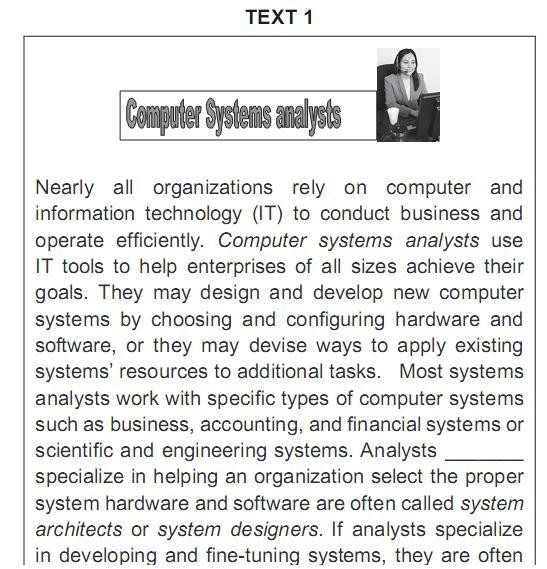
Questions 21 to 23: Choose the CORRECT alternative to answer questions 21 to 23 according to TEXT 02.

Write True ( T ) or False ( F ).
If someone has a healthy diet, it is likely for this person to
( ) be helped to keep a healthy weight.
( ) be protected from most short-term illnesses.
( ) have the possibility of getting cancer increased.
Choose the right sequence:
The main purpose of Text 1 is to
READ TEXT I AND ANSWER QUESTIONS 21 TO 25:
TEXT I
The integral approach strategies adopted by
Favela-Bairro consist of proposals of integrated and
participative actions. The path that goes from welfare
to work should combine programs and services for
human and social development with labor and incomegeneration
opportunities. To be viable, however, social
promotion interventions should be focused on
geographical areas with a high concentration of poverty,
specifically on the poorest families.
An intersectoral decentralized and participative
approach can produce synergetic effects capable of
providing greater impact for poverty and inequality
reduction policies, and capable of contributing to their
sustainability.
Although Favela-Bairro has been based on the idea
of integrated urban infrastructure interventions, initially
the program did not incorporate all the basic components
of an integral approach strategy. These components
weregradually incorporated into its design as a result
of the participatory process and the transformations
that occurred in the municipal administration.
Favela-Bairro is the result of an evolving process
that resulted in the creation of a typical integral
development model with a territorial base that
incorporates life-cycle perspectives.
Rio de Janeiro inhabitants, either living in favelas
or not, recognize the importance of the Favela-Bairro
program. A public opinion poll carried out in 2003 asked
cariocas (as Rio residents are called) to choose from
a list of governmental programs the one to which the
next mayor should give priority. Favela-Bairro was
chosen in first place in all three rounds of the survey.
The same institute asked respondents about the most
important project for the city, and again Favela-Bairro
ranked first: 26.1 percent of respondents have elected
Favela-Bairro as more important than programs such
as minimum income, popularrestaurants, and even
essential works in major city roads.
(www.worldbank.org on September 10, 2005)
should in "to which the next mayor should give priority" (l. 30/31) expresses a(n):
It has become clear that preventive diplomacy is only one
of a class of actions that can be taken to prevent disputes from
turning into armed conflict. Others in this class are preventive
deployment of military and(or) police personnel; preventive
humanitarian action, for example, to manage and resolve a
refugee situation in a sensitive frontier area; and preventive
peace-building, which itself comprises an extensive menu of
possible actions in the political, economic and social fields,
applicable especially to possible internal conflicts.
All these preventive actions share the following
characteristics: they all depend on early warning that the risk of
conflict exists; they require information about the causes and
likely nature of the potential conflict so that the appropriate
preventive action can be identified; and they require the consent
of the party or parties within whose jurisdiction the preventive
action is to take place.
The element of timing iscrucial. The potential conflict
should be ripe for the preventive action proposed. Timing is also
an important consideration in peace-making and peace-keeping.
The prevention, control and resolution of a conflict is like the
prevention, control and cure of a disease. If treatment is
prescribed at the wrong moment in the evolution of a disease, the
patient does not improve, and the credibility of both the treatment
and the physician who prescribed it is compromised.
Internet: (with adaptations).
From text II, it can be deduced that
preventive diplomatic actions should rely on previous intelligence.
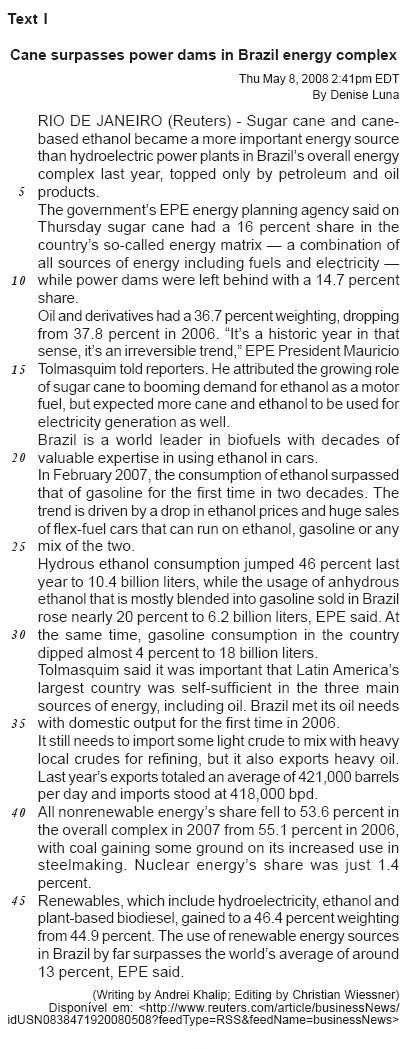
Based on Paragraph 1, it is correct to say that
A "pollution-free" energy source (line 27) means an energy source that is free of pollution. Check the option in which the phrase is also correctly explained.
It is possible to deduce from lines 13-18 that:
Read the text below which is entitled The global union in
order to answer questions 25 to 27.
The global union
Source: Newsweek Special Edition
Dec 2005 Feb 2006 (Adapted)
What would a global union look like? Think more
corporate partnership than class struggle. Today, capital is
global and employers are global. Companies, not countries,
make the rules. To survive, unions need to find their niche.
Global companies are going to need an organization that,
in a sense, will manage their labor and protect workers
rights. A global union would set standard practices and
codes of conduct perhaps even minimum wages and
work hours.
My critics in the labor movement cringe when I use
words like partnership and value added. The reality is
that unions need to add value or corporations will ignore
us. If we want an equitable stake in the company, we need
to define what our goals are. We cant just demand a raise
in pay withoutoffering an incentive to the company. Were
already far behind multinational corporations in the global
game. We made the mistake of transferring the industrial
model of unionism of the last country to the 21st. We lost
market share: in 1960, one in four workers was in a union;
now its one in 12.
According to Professor Avner Offer, affluence
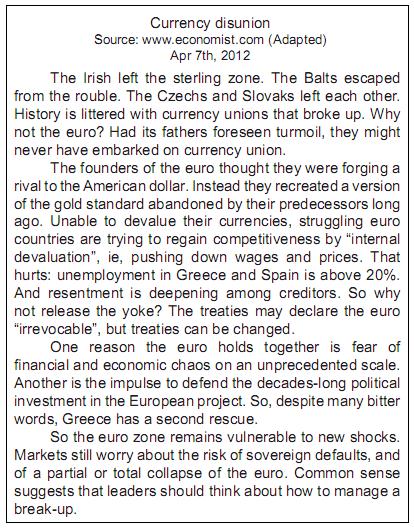
In paragraph 2, the author points out that struggling euro countries are
In the sentence "since this is a key to making their products more competitive." (lines 24-25), the word "since":

According to paragraph 4,

According to Paragraph 2, oil consumption
Read text II and answer questions 37 to 40.
TEXT II
If you think that theres something oddly familiar about
descriptions of social media, it may be that you recall some of
the discussions in the 1990s about what the web would
become. And many of its emerging manifestations are close to
the idealistic imaginings from that time. A good way to think
about social media is that all of this is actually just about being
human beings. Sharing ideas, cooperating and collaborating to
create art, thinking and commerce, vigorous debate and
discourse, finding people who might be good friends, allies and
lovers its what our species has built several civilisations on.
Thats why it is spreading so quickly, not because its great
shiny, whizzy new technology, but because it lets us be
ourselves only more so. And it is in the more so that the
power of this revolution lies. People can find information,
inspiration, like-minded people,communities and collaborators
faster than ever before. New ideas, services, business models
and technologies emerge and evolve at dizzying speed in social
media.
(http://www.icrossing.co.uk/fileadmin/uploads}
/eBooks/What_is_social_media_Nov_2007.pdf
The underlined expression in evolve at dizzying speed can be replaced by
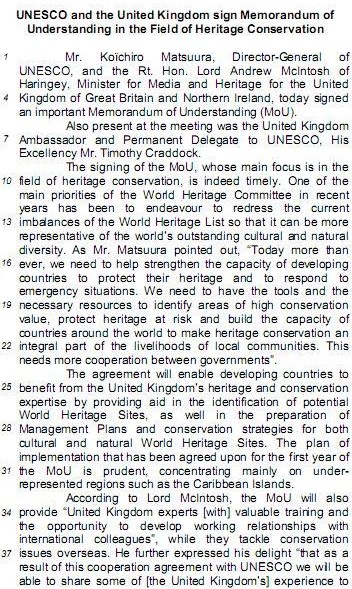

According to the text IV, mark the correct alternative.
DIRECTIONS: Choose the CORRECT alternative to
answer questions 16 to 25.
Questions 16 to 20: Choose the CORRECT alternative to
answer questions 16 to 20, according to TEXT 01.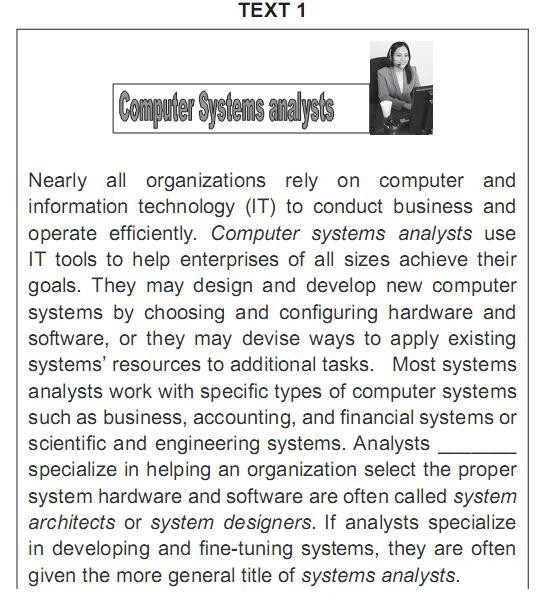

Write True ( T ) or False ( F ).
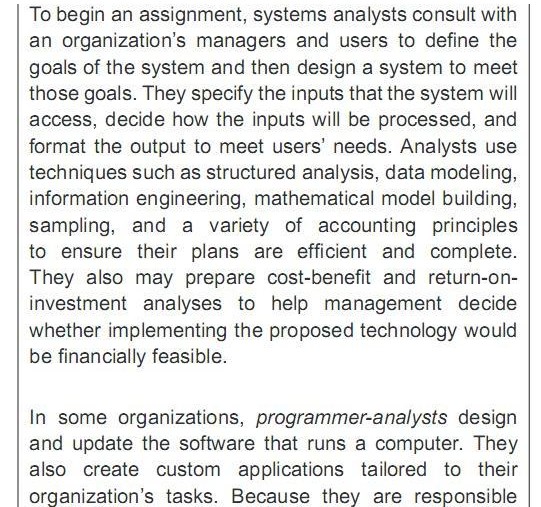
( ) IT tools intend to give support to different companies to reach their aims.
( ) Computer systems analysts are not allowed to design and develop new computer systems.
( ) Only a very restricted group of Computer systems analysts work with specific types of computer systems.
Choose the right sequence:
Based on the text, it is correct to affirm that
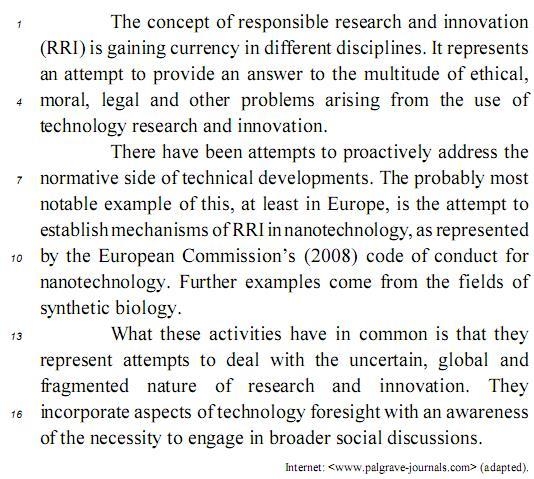
establishing a code of conduct for the use of nanotechnology is more important than regulating research in the fields of synthetic biology.
Based on the text II, mark the correct alternative.
READ TEXT I AND ANSWER QUESTIONS 21 TO 25:
TEXT I
The integral approach strategies adopted by
Favela-Bairro consist of proposals of integrated and
participative actions. The path that goes from welfare
to work should combine programs and services for
human and social development with labor and incomegeneration
opportunities. To be viable, however, social
promotion interventions should be focused on
geographical areas with a high concentration of poverty,
specifically on the poorest families.
An intersectoral decentralized and participative
approach can produce synergetic effects capable of
providing greater impact for poverty and inequality
reduction policies, and capable of contributing to their
sustainability.
Although Favela-Bairro has been based on the idea
of integrated urban infrastructure interventions, initially
the program did not incorporate all the basic components
of an integral approach strategy. These components
weregradually incorporated into its design as a result
of the participatory process and the transformations
that occurred in the municipal administration.
Favela-Bairro is the result of an evolving process
that resulted in the creation of a typical integral
development model with a territorial base that
incorporates life-cycle perspectives.
Rio de Janeiro inhabitants, either living in favelas
or not, recognize the importance of the Favela-Bairro
program. A public opinion poll carried out in 2003 asked
cariocas (as Rio residents are called) to choose from
a list of governmental programs the one to which the
next mayor should give priority. Favela-Bairro was
chosen in first place in all three rounds of the survey.
The same institute asked respondents about the most
important project for the city, and again Favela-Bairro
ranked first: 26.1 percent of respondents have elected
Favela-Bairro as more important than programs such
as minimum income, popularrestaurants, and even
essential works in major city roads.
(www.worldbank.org on September 10, 2005)
According to the text, Favela-Bairro adopted the integral approach methodology:
Judge the following items about the ideas and the linguistic
structures of the text above.
The aviation industry will have a 50% reduction in fuel consumption by 2020, thus cutting CO2 emissions in half.
Suas atualizações recentes
Nenhuma notificação.