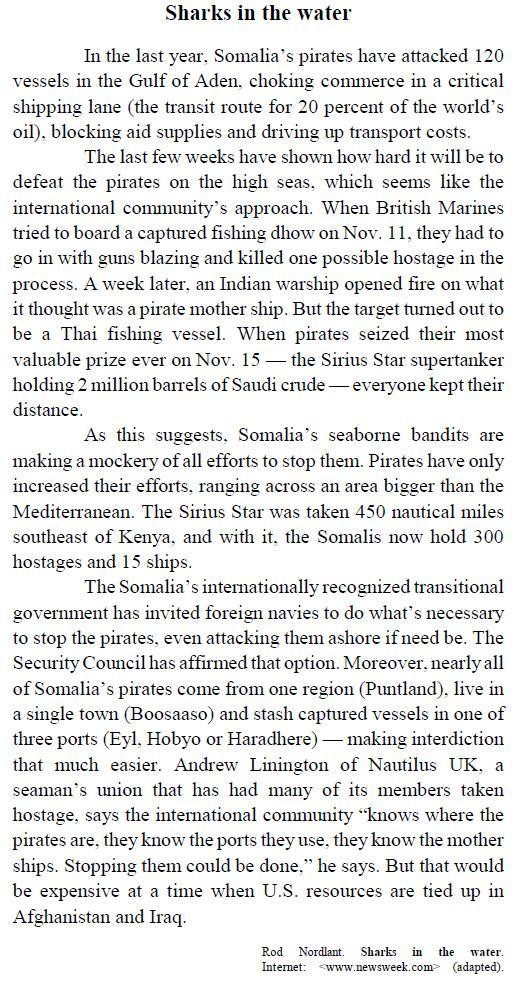
Judge the following items according to the text.
an Indian warship attacked a supposed pirate mother ship which was, nevertheless, a fishing vessel.
Judge the following items according to the text.
an Indian warship attacked a supposed pirate mother ship which was, nevertheless, a fishing vessel.
Read the text below which is entitled The perils of
prosperity in order to answer questions 28 to 30.
The perils of prosperity
Source: The Economist
April 27th 2006 (Adapted)
Midway through the first decade of the 21st century,
economic growth is pulling millions out of poverty. Growth,
so devoutly desired yet often so elusive for developing
countries, is occurring in China and India on a heroic scale.
Yet once affluence is achieved, its value is often questioned.
In the 1960s and 1970s, economists started worrying about
environmental and social limits to growth. Now Avner Offer,
professor of economic history at Oxford University, has
added a weighty new critique to this tradition.
The Challenge of Affluence accepts that the
populations of poor countries gain from growth, but says
that the main benefits of prosperity are achieved at quite
modest levels. Its central thesis is that rising living standards
in Britain andAmerica have engendered impatience, which
undermines well-being. The fruits of affluence are bitter
ones, and include addiction, obesity, family breakdown and
mental disorders.
According to the text, the number of workers affiliated to a union has
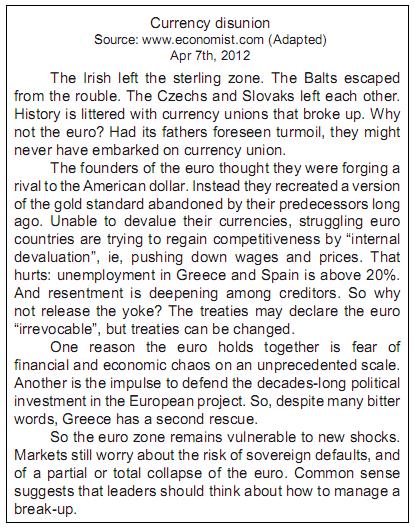
In paragraph 3, the author tries to explain why the euro
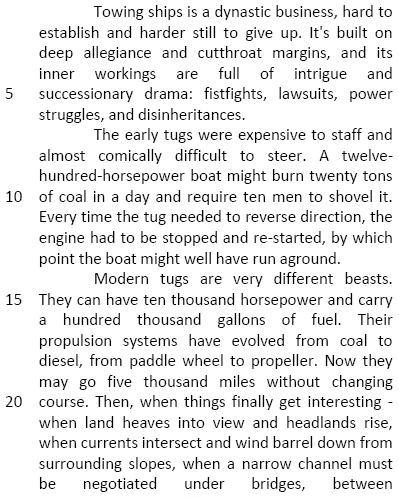
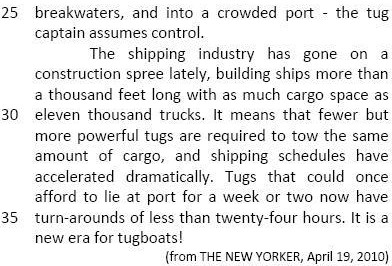
According to paragraph 4,
The underlined word in "a backlash of public opinion" (lines 7 and 8) implies a
READ TEXT I AND ANSWER QUESTIONS 21 TO 25:
TEXT I
The integral approach strategies adopted by
Favela-Bairro consist of proposals of integrated and
participative actions. The path that goes from welfare
to work should combine programs and services for
human and social development with labor and incomegeneration
opportunities. To be viable, however, social
promotion interventions should be focused on
geographical areas with a high concentration of poverty,
specifically on the poorest families.
An intersectoral decentralized and participative
approach can produce synergetic effects capable of
providing greater impact for poverty and inequality
reduction policies, and capable of contributing to their
sustainability.
Although Favela-Bairro has been based on the idea
of integrated urban infrastructure interventions, initially
the program did not incorporate all the basic components
of an integral approach strategy. These components
weregradually incorporated into its design as a result
of the participatory process and the transformations
that occurred in the municipal administration.
Favela-Bairro is the result of an evolving process
that resulted in the creation of a typical integral
development model with a territorial base that
incorporates life-cycle perspectives.
Rio de Janeiro inhabitants, either living in favelas
or not, recognize the importance of the Favela-Bairro
program. A public opinion poll carried out in 2003 asked
cariocas (as Rio residents are called) to choose from
a list of governmental programs the one to which the
next mayor should give priority. Favela-Bairro was
chosen in first place in all three rounds of the survey.
The same institute asked respondents about the most
important project for the city, and again Favela-Bairro
ranked first: 26.1 percent of respondents have elected
Favela-Bairro as more important than programs such
as minimum income, popularrestaurants, and even
essential works in major city roads.
(www.worldbank.org on September 10, 2005)
In relation to Favela-Bairro, the survey indicated that city dwellers have shown to be:
Mark the correct statement concerning the ideas expressed in Paragraphs 6 and 7.

You are in London for the f rst time. You go to a supermarket because you want to buy some fresh vegetables. You f nd the sign above near the till.
So you conclude that you can:
Which alternative contains a correct correspondence of meaning?
It has become clear that preventive diplomacy is only one
of a class of actions that can be taken to prevent disputes from
turning into armed conflict. Others in this class are preventive
deployment of military and(or) police personnel; preventive
humanitarian action, for example, to manage and resolve a
refugee situation in a sensitive frontier area; and preventive
peace-building, which itself comprises an extensive menu of
possible actions in the political, economic and social fields,
applicable especially to possible internal conflicts.
All these preventive actions share the following
characteristics: they all depend on early warning that the risk of
conflict exists; they require information about the causes and
likely nature of the potential conflict so that the appropriate
preventive action can be identified; and they require the consent
of the party or parties within whose jurisdiction the preventive
action is to take place.
The element of timing iscrucial. The potential conflict
should be ripe for the preventive action proposed. Timing is also
an important consideration in peace-making and peace-keeping.
The prevention, control and resolution of a conflict is like the
prevention, control and cure of a disease. If treatment is
prescribed at the wrong moment in the evolution of a disease, the
patient does not improve, and the credibility of both the treatment
and the physician who prescribed it is compromised.
Internet: (with adaptations).
Based on text II, it can be concluded that
in any case, the sooner preventive actions are implemented the better.
Scientists have always been able to forecast ocean currents.
From paragraph 2 we deduce that
Companies in the rich world are confronted with a rapidly
ageing workforce. Nearly one in three American workers
will be over 50 by 2012, and America is a young country
compared with Japan and Germany. China is also ageing
rapidly, thanks to its one-child policy. This means that
companies will have to learn how to manage older workers
better.
Most companies are remarkably ill-prepared. There was a
fl icker of interest in the problem a few years ago but it was
snuffed out by the recession. The management literature
on older workers is a mere molehill compared with the
mountain devoted to recruiting and retaining the young.
Companies are still stuck with an antiquated model for
dealing with ageing, which assumes that people should
get pay rises and promotions on the basis of age. They
have dealt with the burdens of this model by periodically
"downsizing" older workers or encouraging them to take
early retirement. This has created a dual labour market for
older workers, of cosseted insiders on the one hand and
unemployed or retired outsiders on the other.
But this model cannot last. The number of young people,
particularly those with valuable science and engineering
skills, is shrinking. And governments are raising retirement
ages and making it more diffi cult for companies to shed
older workers, in a desperate attempt to cope with their
underfunded pension systems.
Feb 4th 2010 | From The Economist print edition [adapted]
The text suggests that the governments of industrialized countries are
According to paragraph 3, Mr Ponta
Green is the hot topic these days, and the concept
is having an impact on the way people think about
datacenters. Companies around the world are
announcing ways to save energy and reduce costs by
5 buying new hardware and services. Yet, there is little
guidance on how you can take action to control energy
costs. In the past, electricity has been treated as an
overhead expense, like the cost of space. But with rising
power costs and issues regarding reliability, supply, and
10 capacity, electricity requires its own specific strategy.
Projects regarding performance optimization and
cost reduction are a part of everyday best practices
In Paragraph 4, the author:
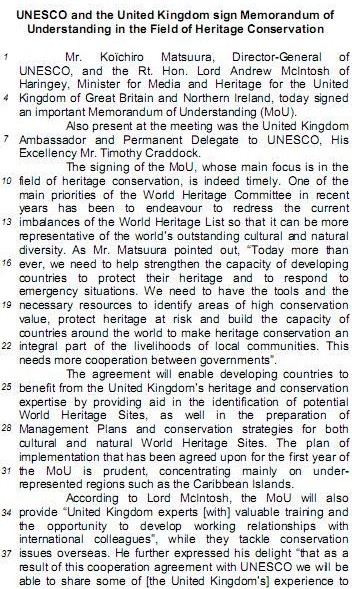

The text IV deals with
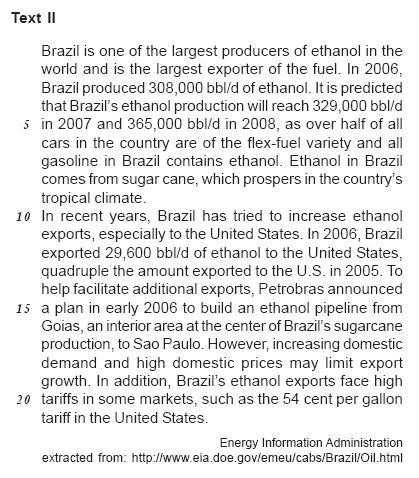
According to Paragraph 2 in Text II, Brazilian exports of canebased ethanol
It has become clear that preventive diplomacy is only one
of a class of actions that can be taken to prevent disputes from
turning into armed conflict. Others in this class are preventive
deployment of military and(or) police personnel; preventive
humanitarian action, for example, to manage and resolve a
refugee situation in a sensitive frontier area; and preventive
peace-building, which itself comprises an extensive menu of
possible actions in the political, economic and social fields,
applicable especially to possible internal conflicts.
All these preventive actions share the following
characteristics: they all depend on early warning that the risk of
conflict exists; they require information about the causes and
likely nature of the potential conflict so that the appropriate
preventive action can be identified; and they require the consent
of the party or parties within whose jurisdiction the preventive
action is to take place.
The element of timing iscrucial. The potential conflict
should be ripe for the preventive action proposed. Timing is also
an important consideration in peace-making and peace-keeping.
The prevention, control and resolution of a conflict is like the
prevention, control and cure of a disease. If treatment is
prescribed at the wrong moment in the evolution of a disease, the
patient does not improve, and the credibility of both the treatment
and the physician who prescribed it is compromised.
Internet: (with adaptations).
Based on text II, it can be concluded that
preventive diplomacy demands just two conditions to succeed.
It has become clear that preventive diplomacy is only one
of a class of actions that can be taken to prevent disputes from
turning into armed conflict. Others in this class are preventive
deployment of military and(or) police personnel; preventive
humanitarian action, for example, to manage and resolve a
refugee situation in a sensitive frontier area; and preventive
peace-building, which itself comprises an extensive menu of
possible actions in the political, economic and social fields,
applicable especially to possible internal conflicts.
All these preventive actions share the following
characteristics: they all depend on early warning that the risk of
conflict exists; they require information about the causes and
likely nature of the potential conflict so that the appropriate
preventive action can be identified; and they require the consent
of the party or parties within whose jurisdiction the preventive
action is to take place.
The element of timing iscrucial. The potential conflict
should be ripe for the preventive action proposed. Timing is also
an important consideration in peace-making and peace-keeping.
The prevention, control and resolution of a conflict is like the
prevention, control and cure of a disease. If treatment is
prescribed at the wrong moment in the evolution of a disease, the
patient does not improve, and the credibility of both the treatment
and the physician who prescribed it is compromised.
Internet: (with adaptations).
Based on text II, it can be concluded that
the physician and the diplomat both play the same role in armed conflicts.
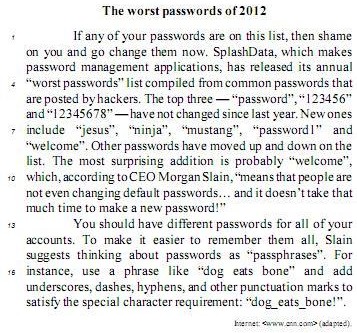
Based on the text above, judge the following items.
Morgan Slain believes people do not change passwords because its time consuming.
Suas atualizações recentes
Nenhuma notificação.