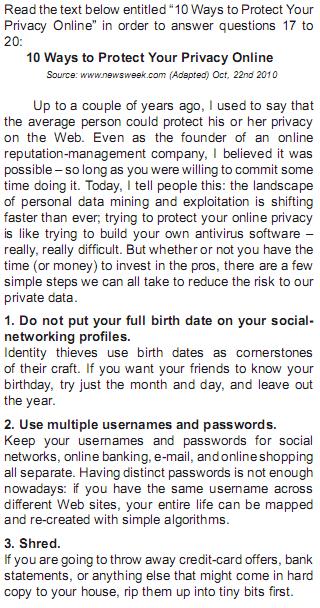
According to the author, reducing the risk to our private data is

According to the author, reducing the risk to our private data is

Accidents in software development projects and products are nothing new and neither are they likely to cease.

Based on the text above, judge the following items.
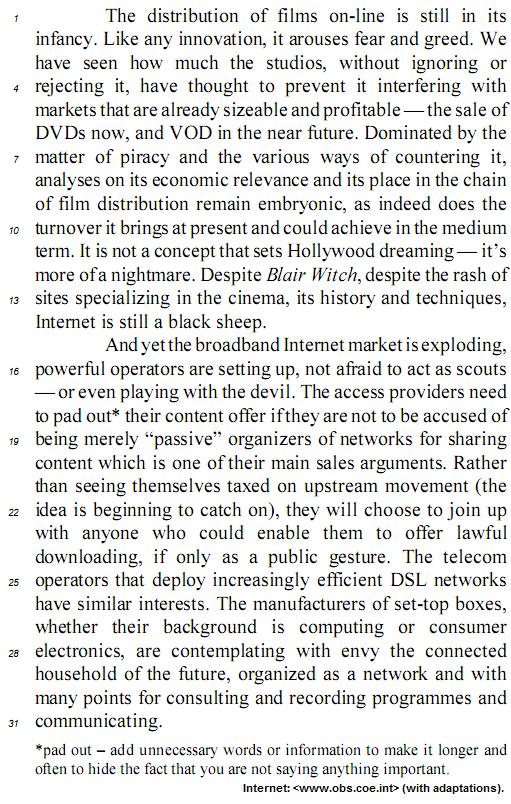
The access providers get together with anyone who could make them able to offer lawful downloading just as a public gesture.

As Dekker has posed, investigators should focus on the circumstances of the time and disregard knowledge of the outcome.

The current models employed to investigate software accidents do not appear to be suited to the task.
Considering Text II, write 1 for “iGeners” or 2 for “Millennials” to complete the following sentences.
( ) … can be referred to as ‘digital natives’.
( ) … were born between the early 1980s and 1990s.
( ) … dominate most social networking groups.
( ) … had to adapt quickly to a world undergoing rapid technological changes.
The correct sequence downwards is

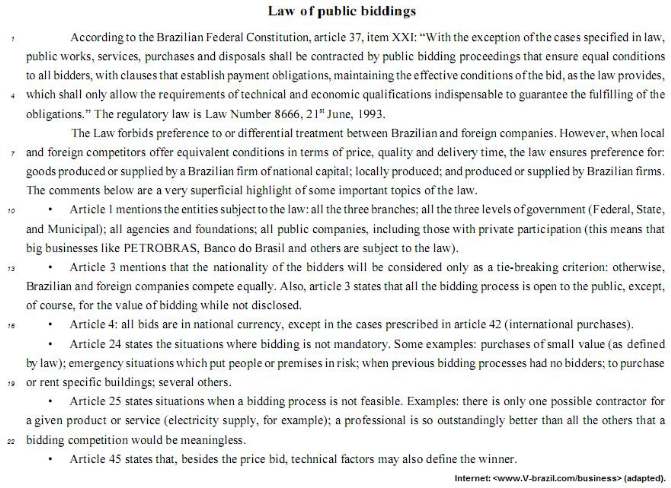
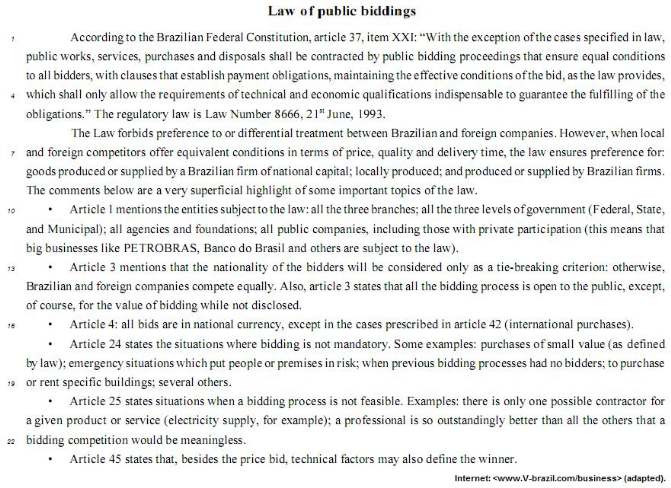
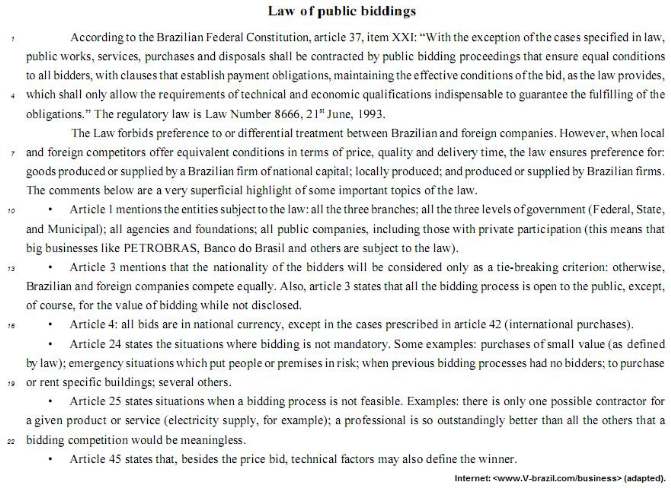
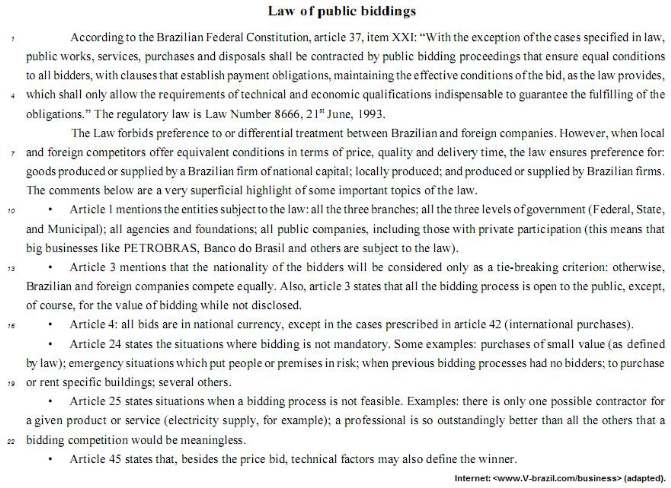
Public companies are exempt from the bidding process.

Only bidders are allowed in all of the bidding process.
iGen teens _______________________
I. have a digital bond to the Internet.
II. have been exposed to an unprecedented amount of technology in their upbringing.
III. belong to the first generation to have always had Internet technology readily available.
According to the text, the sentence above can be correctly completed with the elements in

Based on the text above, judge the following items.
The distribution of films may be a nightmare, whereas the broadband Internet is succeeding pretty well.

"those" (L.11) refers to "public companies" (L.11).
Text LI-I conveys the idea that 1
the Federal Government has made massive investments on strategies to improve software development.

However low a price bid may be, it still may not be the winner if technical factors are not up to standards.
Your answers to questions 21 to 24 must be based on the
text below entitled "A dip in the middle":
A dip in the middle
Source: The Economist (adapted)
Sep 8th 2005
Income tax has been paid in Britain for more
than two centuries. First introduced by William Pitt the
Younger to finance the war against Napoleonic France,
it is the Treasury´s biggest source of revenue, raising
30% of tax receipts. It arouses strong political emotions,
regarded as fair by some because it makes the rich pay a
bigger share of their income than the poor, but unfair by
others because it penalizes enterprise and hard work.
During the past 30 years, income tax has been
subject to sweeping changes, notably the cut in the top
rate from 98% to 40% under Margaret Thatcher between
1979 and 1988. Now another Conservative politician,
George Osborne, is floating a radical reform to match
that earlier exploit. The shadow chancellor announced
on September 7ththat he was setting up a commission
to explore the possible introduction of a flat income tax
in Britain.
Introducing a flat income tax into Britain would
involve two main changes. At present, there are three
marginal tax rates. These three rates would be replaced
by a single rate, which would be considerably lower than
the current top rate. At the same time there would be an
increase in the tax-free personal allowance, currently
worth 4,895 pounds.
In paragraph 3, the author notes that the present tax-free personal allowance would
more than a dozen of reasons contribute to the software gap.
Suas atualizações recentes
Nenhuma notificação.