(UFGD MS/2016) Leia um trecho do poema de Edgar Allan Poe e as afirmações a seguir.

The Raven (by Edgar Allan Poe)

Once upon a midnight dreary, while I pondered, weak and weary,
Over many a quaint and curious volume of forgotten lore—
While I nodded, nearly napping, suddenly there came a tapping,
As of some one gently rapping, rapping at my chamber door.
“’Tis some visitor,” I muttered, “tapping at my chamber door—
Only this and nothing more.”
Ah, distinctly I remember it was in the bleak December;
And each separate dying ember wrought its ghost upon the floor.
Eagerly I wished the morrow;—vainly I had sought to borrow
From my books surcease of sorrow—sorrow for the lost Lenore—
For the rare and radiant maiden whom the angels name Lenore—
Nameless HERE for evermore.

POE, Edgar Allan. The Raven, 1845. Disponível em: poetryfoundation.org/poem/178713>. Acesso em: 23 out. 2015.

Está correto apenas o que se afirma em

I. O poema de Edgar Allan Poe está na primeira pessoa do singular.

II. O trecho “Once upon a midnight dreary, while I pondered, weak and weary”, pode ser traduzido como “Certa vez, numa meia-noite lúgubre, enquanto meditava, fraco e cansado”.

III. Bleak in “Distinctly I remember it was in the bleak December” pode ser substituído por black, sem perda do efeito de sentido.

IV. O pronome relativo whom em “For the rare and radiant maiden whom the angels name Lenore refere-se a anjos”.

Which is the correct option to complete the sentence below?
My son is allergic to sea food. If he (1)__________________ shrimps, for example, his throat (2)_________________ immediately.
Read the following expression and match each one to the correct definition:

I. “A blessing in disguise”
II. “Beat around the bush”
III. “Bite the bullet”
IV. “Call it a day”

( ) “avoid saying what you mean, usually because it is uncomfortable” ( ) “to get something over with because it is inevitable” ( ) “a good thing that seemed bad at first” ( ) “stop working on something”

According to the established rules of phonetics and phonology of the English language, judge the items below.

In the following words, the initial h is never silent: hate, hello, honest, history.

From "Conclusion on Global Warming":

One of the big questions of today is whether global warming and climate change can be stopped or whether it is inevitable. Though worried, most scientists believe that if we act now, “serious” climate change and global warming can be avoided. A few, such as James Lovelock who created the GAIA theory of the Earth as a living organism, believes that is far too late to stop the changes that
are now unfolding. Politicians either deny that there is a problem or act as if there is plenty of time to do something. After weighing the arguments we in The GAIA-Movement have had to conclude the following:

• Global Warming and Climate Change are unavoidable as they are already going on and have been so for quite some time;

• they constitute an inevitable catastrophe that will unfold in the years and decades to come;

• this fact cannot be reversed as the politicians in power will not provide the leadership needed to implement the monumental changes needed to reduce greenhouse gas emission and

• the processes set in motion are of such magnitude that they by now can only be postponed or prolonged so as to allow more time for adaptation.

We have reached our conclusions on global warming, climate change and the consequences thereof for food production and a number of other issues after studying books, films, websites, radio interviews, scientific magazines and reports.
The information we have found points in a clear direction and has thus enabled us to make a clear conclusion.
A basic book has been “Six Degrees” by Mark Lynas, a journalist who has studied many scientific reports and from that has been able to describe what may happen to the Earth as it warms 1-2-3-4-5 and even 6 degrees.
Elizabeth Kolbert has written “Field Notes from a Catastrophe”. She has met many scientists working on global warming and the book has much dramatic information.
Several other authors have written books that give many details on global warming and climate change such as “The Last Generation” by Fred Pierce, “The Weather Makers” by Tim Flannery,A Rough Guide to Climate Change” by Robert Henson, “The Revenge of GAIA” by James Lovelock and “An Inconvenient Truth” by Al Gore, who received the Nobel Peace Prize for his effort to inform about climate change. The last book is also on film and there are several other films that tell about different aspects of climate change and what can be done to build a world on renewable energy.
The Intergovernmental Panel on Climate Change, a UN working group, which also received the Nobel Peace Prize made their latest report in 2007. We have studied the report which presents several models for how the climate may change during the next 100 years.

Text taken from the Gaia Movement: http://www.gaia-movement.org/
On: 10/23/2009
“Gaia” is the name of a Greek goddess of Earth.
According to the text what’s the inevitable catastrophe that will unfold in the years and decades to come?
Analise a frase abaixo e assinale a alternativa CORRETA relacionada a falsos cognatos das palavras em destaque: She chose a college without prejudice for her relative.

Imagem 001.jpg

Based on the text, it is correct to affirm that

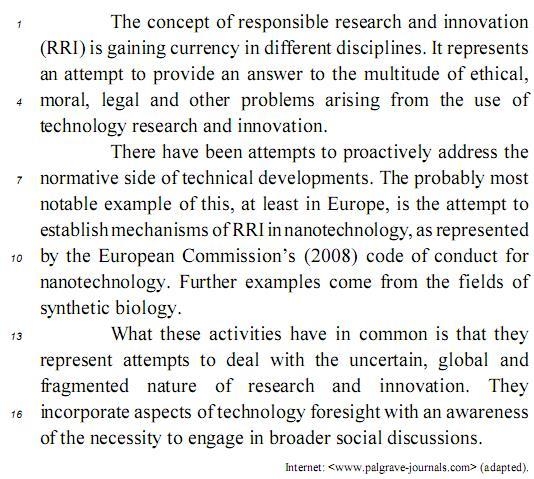
responsible research and innovation is a field of study which has played a significant role in research and development providing answers to the multitude of problems arising from the use of technology.

The text below is part of the Japanese tale “My Lord Bag of Rice”:

“Long, long ago there lived in Japan a brave warrior known to all as Tawara Toda or “My Lord Bag of Rice”. His true name was Fujiwara Hidesato and there is a very interesting story of how he came to change his name. One day he went out in search of adventures because he had the nature of a warrior and could not bear to be idle. So he picked up his two swords, took his huge bow, which was much taller than himself, in his hand, strapped his quiver on his back and started out.

He had not gone far when he came to the bridge of Seta-no-Karashi crossing one end of the beautiful Lake Biwa. As soon as he stepped on the bridge, he saw lying right across his path a huge serpent-dragon. Its body was so big that it looked like the trunk of a large pine tree and it took up the whole width of the bridge. One of its huge claws rested on the parapet of one side of the bridge while its tail lay right against the other. The monster seemed to be asleep, and as it breathed, fire and smoke came out of its nostrils.

At first, Hidesato could not help feeling alarmed at the sight of this horrible reptile lying in his path, for he must either turn back or walk right over its body.” 

What did the warrior strap on his back?
                  The cabin crew battled to save the passenger
                                                                                               Ben Graham
        Shocked passengers watched as doctors and cabin crew tried
to  save  the   life  of  a  critically ill passenger on a Qantas flight to
Sidney on Friday.
        A     Qantas    spokeswoman   confirmed  that  the  passenger
__________ received    tratment   during   the    medical   emergency
couldn’t survive.
        The   flight  from London, via Singapore, was forced to land in
Adelaide  because of the incident. No passengers got off the flight
while it was in Adelaide.
         A  witness  on board told that everything started with a cabin
announcement  asking  for any doctors on board. There were two
passengers  with  medical  training,  but  nothing could be done to
save  the passenger. The crew did everything they could, including
performing  CPR  with  a  doctor  on   board, but unfortunately the
passenger has passed away.
                                                                       Adapted from nypost.com
In “The crew did everything they could (...)”, the modal “could” is used to indicate
The authors have insisted ___ explaining about reading strategies.

How can you reply to this statement? I had a difficult test yesterday.

Two of the greatest technologies of our age are telecommunications and computer engineering. Telecommunications is concerned with moving information from one point to another point or from one point to many other points. I think it is no exaggeration to say that the telecommunications industry is largely taken for granted by the vast majority of people. If you were to ask the average person what the greatest technological feat of 1969 was, they would probably reply ‘The first manned landing on the moon’. A much more magnificent achievement was the ability of millions of people half a million kilometres away to watch what was taking place on the moon in their own homes. However, if most people are not aware of the great developments in the telecommunications industry, they will not have missed the microprocessor revolution. In the last few years powerful computers have become even more powerful and minicomputers and microprocessors have spread to industry, education, research, and the home.

(Extraído de: The Principles of Computer Hardware, Alan Clements, International Student Edition, 2nd, 1991)
No texto, o termo aware tem o significado de:

Complete the sentence with the best relative pronouns respectively:

“Albert Sabin, ____ has never won a Nobel Prize, invented an oral vaccine ____ prevents the poliomyelitis.”

In regard to error treatment and language teaching methods, decide about the correctness of the items below.

In Communicative Language Teaching (CLT), errors of form are tolerated during fluency-based activities and are seen as a natural outcome of the development of communication skills. The teacher may note the errors during fluency activities and return to them later with an accuracy-based activity.

     It now seems to me that what matters most in the majority
of organizations is to have reasonably intelligent, hard-working
managers who have a sense of pride and loyalty toward their
organization; who can get to the root of a problem and are inclined
toward action; who are decent human beings with a natural empathy
and concern for people; who possess humor, humility, and common
sense; and who are able to couple drive with stick-to-it-iveness* and
patience in the accomplishment of a goal.
     It is the ability to make positive things happen that most
distinguishes the successful manager from the mediocre or
unsuccessful one. It is far better to have dependable managers who
can make the right things happen in a timely fashion than to have
brilliant, sophisticated, highly educated executives who are excellent
at planning and analyzing, but who are not so good at implementing.
The most cherished manager is the one who says “I can do it,” and
then does.
     Many business schools continue to focus almost exclusively
on the development of analytical skills. As a result, these schools are
continuing to graduate large numbers of students who know a great
deal about analyzing strategies, dissecting balance sheets, and using
computers — but who still don’t know how to manage!
     As a practical matter, of course, schools can go only so far
in teaching their students to manage. Only actual work experience
will fully develop the kinds of managerial traits, skills, and virtues
that I have discussed here.

*the ability and determination to continue doing something despite difficulties.
Wegman, Knezevic, Bernstein. A reading skills book, 3.d
ed. Mac Graw-Hill Companies, Inc. (adapted).

Based on the text above, judge the items below.
The workers’ success depends on how good things come to happen.
Página 16