Questões de Concursos
selecione os filtros para encontrar suas questões de concursos e clique no botão abaixo para filtrar e resolver.
Select the right option:
"She wants to buy ___ new phone."
Complete the sentences with the correct form of the verbs in the passive voice:
I. The camp __________ by the rain.
II. Tea __________ at 4.
Which alternative best completes the sentence below? (* means no article)
_______ good book is ________ best medicine for ________ loneliness.
It can be said about the criteria used to rate countries on this survey that they


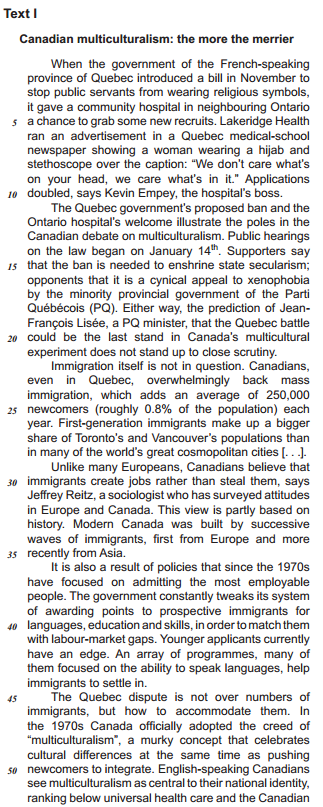
In Text I, the author suggests that
Qual é a forma correta do verbo auxiliar "be" para a terceira pessoa do singular (he, she, it) no passado simples?
Read the text below entitled `While Rome burns´ in order to answer questions 22 to 25:
While Rome burns
Source: www.economist.co.uk
Sep 25th, 2008 (Adapted)
American plans to buy up assets that are clogging the fi nancial system lack detail but no one doubts that a massive government intervention is coming. In Europe jittery investors have no such reassurance. European governments have yet to respond publicly to calls from Hank Paulson, the treasury secretary, to follow his lead. They look set to keep faith with the approach that they have used to handle the crisis so far ? staving off liquidity worries by allowing banks to use facilities at central banks to swap their assets in exchange for ready cash. That makes many watchers nervous. The crisis in America has dramatically grown from one of liquidity to one of solvency as well. Lehman Brothers had access to the Federal Reserve´s discount window, after all, but still went under. The burning question now is whether banks have enough capital. On some measures, European banks look pretty well capitalized. The average tier–one ratio, which measures capital based on the riskiness of bank assets, stood at 8% in the fi rst half of the year. That looks solid enough, if you assume that banks have a good handle on risk.
As regards investors in Europe at the moment, they are feeling
The passage "The resolution establishes transparency in all processes and the United Nations participation in monitoring the sale of Iraqi oil resources and expenditure of oil proceeds" in text IV can be replaced by
The conclusion settles down transparency in all processes and the UN will take part in monitoring the sale of Iraqi renewable resources and expenditure.O texto a seguir é referência para as questões 77 a 80.
Germans make wonderful beer. Yet the productivity of the German beer industry is only 43 percent that of the U.S. beer industry. Meanwhile, the German metalworking and steel industries are equal in productivity to their American counterparts. Since the Germans are evidently capable of organizing industries well, why can?t they do so when it comes to beer?
It turns out that the German beer industry suffers from small?scale production. There are a thousand tiny beer companies in Germany, shielded from competition with one another because each German brewery has virtually a local monopoly, and they are also shielded from competition with imports. The United States has 67 major beer breweries, producing 23 billion liters of beer per year. All of Germany?s 1,000 breweries combined produce only half as much. Thus the average U.S. brewery produces 31 times more beer than the average German brewery.
This fact results from local tastes and German government policies. German beer drinkers are fiercely loyal to their local brand, so there are no national brands in Germany analogous to our Budweiser, Miller, or Coors. Instead, most German beer is consumed within 30 miles of the factory where it is brewed. Therefore, the German beer industry cannot profit from economies of scale. In the beer business, as in other businesses, production costs decrease greatly with scale. The bigger the refrigerating unit for making beer, and the longer the assembly line for filling bottles with beer, the lower the cost of manufacturing beer. Those tiny German beer companies are relatively inefficient. There?s no competition; there are just a thousand local monopolies.
The local beer loyalties of individual German drinkers are reinforced by German laws that make it hard for foreign beers to compete in the German market. The German government has so?called beer purity laws that specify exactly what can go into beer. Not surprisingly, those government purity specifications are based on what German breweries put into beer, and not what American, French, and Swedish breweries like to put into beer. Because of those laws, not much foreign beer gets exported to Germany, and because of inefficiency and high prices much less of that wonderful German beer than you would otherwise expect gets sold abroad. (Before you object that German Löwenbräu beer is widely available in the United States, please read the label on the next bottle of Löwenbräu that you drink here: it?s not produced in Germany but in North America, under license, in big factories with North American productivities and efficiencies of scal(E).
(Diamond, J. ,2005. Guns, Germs, and Steel. New York: Norton.)
How does Germany protect its beer industry, according to the text?
Read the text below and choose the alternative that fills in correctly and respectively the blanks.
What Food Labels Really Mean
Walk _______ any supermarket and you?ll find rows of packaged foods boasting how healthy they are. _______ "fatfree" to "natural" _______ "helps your immune system", front–ofthe–box labels may give the appearance _______ good nutrition, but the reality is a bit more complicated. Unlike the Nutrition Facts panel, which is tightly regulated, front–of–the–package food labels aren?t as closely monitored. ________ addition, food companies tend ________ "stretch the envelope" of what?s permitted, says Marion Nestle, professor of nutrition, food studies, and public health _________ New York University. The result, she says: "Many of the health claims you see are misleading."
Available in: http://health.usnews.comnews
It has become clear that preventive diplomacy is only one
of a class of actions that can be taken to prevent disputes from
turning into armed conflict. Others in this class are preventive
deployment of military and(or) police personnel; preventive
humanitarian action, for example, to manage and resolve a
refugee situation in a sensitive frontier area; and preventive
peace-building, which itself comprises an extensive menu of
possible actions in the political, economic and social fields,
applicable especially to possible internal conflicts.
All these preventive actions share the following
characteristics: they all depend on early warning that the risk of
conflict exists; they require information about the causes and
likely nature of the potential conflict so that the appropriate
preventive action can be identified; and they require the consent
of the party or parties within whose jurisdiction the preventive
action is to take place.
The element of timing iscrucial. The potential conflict
should be ripe for the preventive action proposed. Timing is also
an important consideration in peace-making and peace-keeping.
The prevention, control and resolution of a conflict is like the
prevention, control and cure of a disease. If treatment is
prescribed at the wrong moment in the evolution of a disease, the
patient does not improve, and the credibility of both the treatment
and the physician who prescribed it is compromised.
Internet: (with adaptations).
From text II, it can be deduced that
preventive diplomacy has just been considered the only possible action to avoid war.
Which of the alternatives below completes the sentence correctly?
"There ____________(1) people on the wait list in the past
few years whose interest level was inappropriate, " says Meehan.
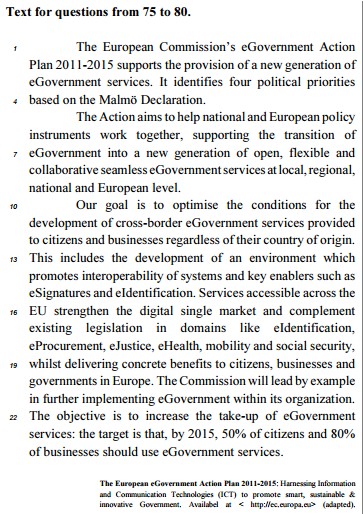
The passage "The resolution establishes transparency in all processes and the United Nations participation in monitoring the sale of Iraqi oil resources and expenditure of oil proceeds" in text IV can be replaced by
The resolution sets up transparency in every process and the United Nations participation in keeping track of the sale of Iraqi oil reserves and expenses of oil proceeds.

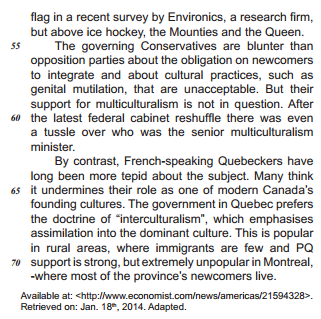
The expression "regardless of" in "regardless of their country of origin" (l.12) can be correctly replaced by


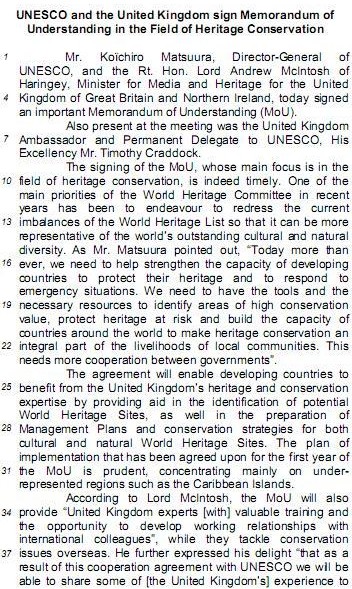
Based on the text IV, mark the correct alternative.

The term likely in - All this matters because the effects of climate change are very real. They are also diverse, and will likely hit hardest in the most vulnerable and poorest regions of the world. - implies
Technology and legal pressure have changed
spammers’ terms of trade. They long relied on sending
more e-mails from more computers, knowing that some
will get through. But it is hard to send 100m e-mails
without someone noticing. In 2008 researchers from the
University of California at Berkeley and San Diego posed
as spammers, infiltrated a botnet and measured its
success rate. The investigation confirmed only 28 “sales”
on 350m e-mail messages sent, a conversion rate
under .00001%. Since then the numbers have got worse.
But spammers are a creative bunch.
of tricking
consumers into a purchase, they are stealing their money
directly. Links used to direct the gullible to a site selling
counterfeits. Now they install “Trojan” software that
ransacks hard drives for bank details and the like.
Spammers also have become more sophisticated
about exploiting trust. In few places is it granted more
readily than on social-networking sites. Twitter, a forum for
short, telegram-like messages, estimates that only 1% of
its traffic is spam. But researchers from the University of
California at Berkeley and the University of Illinois at
Champaign-Urbana show that 8% of links published were
shady, with
of them leading to scams and the rest to
Trojans. Links in Twitter messages, they found, are over
20 times more likely to get clicked than those in e-mail
spam.
Nor is Facebook as safe as it seems. As an
experiment, BitDefender, an online-security firm, set up
fake profiles on the social network and asked strangers to
enter into a digital friendship. They were able to create as
many as 100 new friends a day. Offering a profile picture,
particularly of a pretty woman, increased their odds. When
the firm’s researchers expanded their requests to strangers
who shared even one mutual friend, almost half accepted.
Worse, a quarter of BitDefender’s new friends clicked on
links posted by the firm, even when the destination was
obscured.
(Adapted from http://www.economist.com/node/17519964)
De acordo com o texto,