Fortunately, our knowledge ____ after reading this text.
Questões de Concursos
selecione os filtros para encontrar suas questões de concursos e clique no botão abaixo para filtrar e resolver.
Publicidade
Read the following passage and choose the option that best answers the questions 01 to 05.
"The experienced teacher" (lines 23-24):
some common goals of the activities encompassed by e-governance would certainly include improving efficiency.

This machine runs on a _____ that will make any other seemold.
Texto 3:
Born Too Soon in a Country at War. Their Only Hope? This Clinic. By Kassie Bracken and Megan Special August 27, 2018
The baby girl has stopped breathing. She was born prematurely and is only 3 weeks old. Her mother, Restina Boniface, took her to the only public neonatal clinic in South Sudan. The country is one of the toughest places in the world for newborns with health problems to survive. Ten feet away sits a donated respiratory machine that could save the baby. But lacking a critical part, it goes unused. The doctor tries to resuscitate the baby for several minutes. Finally, she begins breathing on her own. One in 10 babies brought to this clinic will die, most from treatable conditions. But many mothers have nowhere else to go. South Sudan, the world’s youngest nation, is in the midst of a humanitarian crisis. A brutal civil war has drained the economy. As hospitals closed, doctors were forced to flee. Inside the clinic, many babies remain nameless. Their mothers know they may not make it. “Our mothers here, they come for help,” said Rose Tongan, a pediatrician. “And you pity them. You can’t do anything.” Electricity cuts out for days at a time. There is no formula for the premature babies, no lab for blood tests, no facility for X-rays. There are no beds for breastfeeding mothers. They must sleep outside, where they are at risk of infection and vulnerable to assault. “I feel like: What can I do?” Dr. Tongan said. Hellen Sitima’s 3-day-old daughter is sick. “When we get home, then that’s the time to name the baby,” she says. Dr. Tongan has no access to lab tests, but she determines that Ms. Sitima’s baby has a respiratory infection. The infection clears, and Ms. Sitima takes her daughter home. She names her Gift.
Disponível em https://www.nytimes.com/interactive/2018/08/28/multimedia/ south-sudan-babies.html. Acessado em 22/10/2018
O texto relata a situação crítica em que se encontram hospitais no Sudão do Sul e de alguns pacientes que deles precisam para sobreviver. Assim sendo, assinale a alternativa que corresponde ao lido:
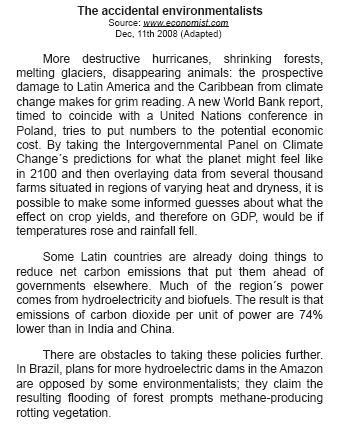
As regards the potential economic cost caused by climate change, figures
" _______ is a set of procedures, i.e., a system that spells out rather precisely how to teach a second or foreign language." The best word that will fill in the blank in the preceding definition is:
Your answers to questions 17 to 20 must be based on the article below entitled "Looming water crisis simply a management problem":
Looming water crisis simply a management problem
Source: www.newscientist.com August 20th 2008 (Adapted)
Today´s focus on the credit crisis and rising prices for food and oil has temporarily put another global scarcity in the shade: water. The UN predicts that by 2025, two-thirds of us will experience water shortages, with severe lack of water blighting the lives and livelihoods of 1.8 billion. According to the UN World Water Assessment Programme, by 2050, 7 billion people in 60 countries may have to cope with water scarcity. At this year´s World Economic Forum, UN secretary-general Ban Ki-moon recommended that water scarcity should be at the top of the international agenda. "As the global economy grows, so will its thirst," he said, warning of a future marred by conflicts over water.
There is no doubt that we need to rethink how we use water, especially with the human population growing rapidly, and global warming likely to produce unpredictable patterns of rainfall and drought. Nevertheless, my own research suggests that the situation may not be as dire as many are suggesting. Nations can thrive on surprisingly meagre quantities of fresh water – provided they adopt water-efficient technologies and encourage economic activity that does not guzzle water. I believe the looming water crisis is primarily a problem of distribution and management rather than supply. And we can solve it with existing technologies, increased investment and political will.
In paragraph 2, the author says that based on his own research, the situation
Choose the answer whose items appropriately complete the sentence below. There were _____ people at the flea market yesterday, but very _____ things were sold.
What option best completes the following sentence
: ?If I had had a baby, _____________________________?
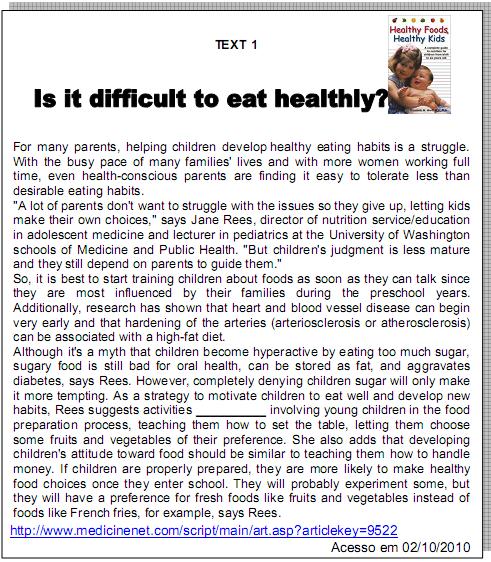
For most parents nowadays, teaching children to eat well is __________.
The option in which the relative pronoun can be omitted without causing any change to either the sentence structure or meaning is
The text as a whole is both
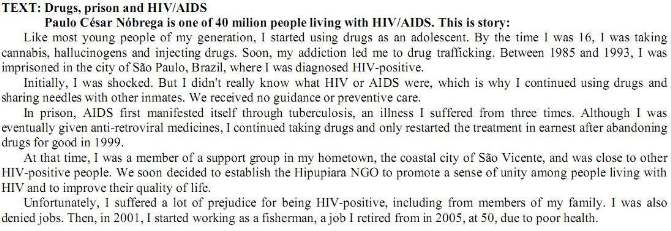

Mr. Nóbrega started dealing drugs:
Read the following sentences I, II, III:
I. I sent a letter to the airline company complaining about the problems I had during the flight and they have promised to look into the matter. II. Although that doctor hasn’t won the Nobel Prize, I look up to him. III. I promised her that I would look after her kids if she weren’t able to do that. It’s correct to say that the meaning of each underline bold phrasal verb is respectivelyAtenção: As questões de números 21 a 48 referem-se aos conhecimentos sobre formação de professores e ensino de língua inglesa.
A principal vantagem de usar um livro didático num curso de língua estrangeira é que ele
Choose the alternative that collacates with the verb to make:
Leia o texto para responder às questões:
The Right to a “Custody Hearing” under International Law
by Maria Laura Canineu
February 3, 2014
A person who is arrested has a right to be brought promptly before a judge. This is a longstanding and fundamental principle of international law, crucial for ensuring that the person’s arrest, treatment, and any ongoing detention are lawful.
Yet, until now, Brazil has not respected this right. Detainees often go months before seeing a judge. For instance, in São Paulo state, which houses 37 percent of Brazil’s total prison population, most detainees are not brought before a judge for at least three months. The risk of ill-treatment is often highest during the initial stages of detention, when police are questioning a suspect. The delay makes detainees more vulnerable to torture and other serious forms of mistreatment by abusive police officers.
In 2012, the UN Subcommittee on Prevention of Torture and Other Cruel, Inhuman or Degrading Treatment or Punishment reported that it had received “repeated and consistent accounts of torture and ill-treatment” in São Paulo and other Brazilian states, “committed by, in particular, the military and civil police.” The torture had allegedly occurred in police custody or at the moment of arrest, on the street, inside private homes, or in hidden outdoor areas, and was described as “gratuitous violence, as a form of punishment, to extract confessions, and as a means of extortion.”
In addition to violating the rights of detainees, these abusive practices make it more difficult for the police to establish the kind of public trust that is often crucial for effective crime control. These practices undermine legitimate efforts to promote public security and curb violent crime, and thus have a negative impact on Brazilian society as a whole.
The right to be brought before a judge without unnecessary delay is enshrined in treaties long ago ratified by Brazil, including the International Covenant on Civil and Political Rights (ICCPR) and the American Convention on Human Rights. The United Nations Human Rights Committee, which is responsible for interpreting the ICCPR, has determined that the delay between the arrest of an accused and the time before he is brought before a judicial authority “should not exceed a few days,” even during states of emergency.
Other countries in Latin America have incorporated this right into their domestic law. For instance, in Argentina, the federal Criminal Procedure Code requires that in cases of arrest without a judicial order, the detainee must be brought to a competent judicial authority within six hours.
In contrast, Brazil’s criminal procedure code requires that when an adult is arrested in flagrante and held in police custody, only the police files of the case need to be presented to the judge within 24 hours, not the actual detainee. Judges evaluate the legality of the arrest and make the decision about whether to order continued detention or other precautionary measures based solely on the written documents provided by the police.
The code establishes a maximum of 60 days for the first judicial hearing with the detainee, but does not explicitly say when this period begins. In practice, this often means that police in Brazil can keep people detained, with formal judicial authorization, for several months, without giving the detainee a chance to actually see a judge.
According to the code, the only circumstance in which police need to bring a person before the judge immediately applies to cases of crimes not subject to bail in which arresting officer was not able to exhibit the arrest order to the person arrested at the time of arrest. Otherwise, the detainee may also not see a judge for several months.
(www.hrw.org. Editado e adaptado)
The UN Subcommittee on Prevention of Torture and Other Cruel, Inhuman or Degrading Treatment or Punishment stated that
The word “anyway”, underlined in the text, was used to __________.
I wish I ______ in this exam
Publicidade