The relative pronoun can be omitted in:
Questões de Concursos
Selecione os filtros para encontrar suas questões de concursos e clique no botão abaixo para filtrar e resolver.
Ordenar por:
Minhas questões:
Selecione os filtros para encontrar suas questões de concursos e clique no botão abaixo para filtrar e resolver.
Nada por aqui
Which sequence best completes the text below?
David Beckham (1) in a minor car accident on Friday. The football ace (2)near Torrence in California when he (3) into the back of a stationary vehicle with his Cadillac SUV.
(Adapted fromhttp://www.thisisiondon.co.uk)
O texto a seguir é referência para as questões 77 a 80.
School Curriculum Falls Short on Bigger Lessons
By Tara PARKER-POPE
Now that children are back in the classroom, are they really learning the lessons that will help them succeed?
Many child development experts worry that the answer may be no. They say the ever-growing emphasis on academic performance and test scores means many children aren?t developing life skills like self-control, motivation, focus and resilience, which are far better predictors of long-term success than high grades. And it may be distorting their and their parents? values.
In one set of studies, children who solved math puzzles were praised for their intelligence or for their hard work. The first group actually did worse on subsequent tests, or took an easy way out, shunning difficult problems. The research suggests that praise for a good effort encourages harder work, while children who are consistently told they are smart do not know what to do when confronted with a difficult problem or reading assignment.
Academic achievement can certainly help children succeed, and for parents there can be a fine line between praising effort and praising performance. Words need to be chosen carefully: Instead of saying, "I?m so proud you got an ?A? on your test", a better choice is "I?m so proud of you for studying so hard". Both replies rightly celebrate the ?A?, but the second focuses on the effort that produced it, encouraging the child to keep trying in the future.
Praise outside of academics matters, too. Instead of asking your child how many points she scored on the basketball court, say, "Tell me about the game. Did you have fun? Did you play hard?". Parents also need to teach their children that they do not have to be good at everything, and there is something to be learned when a child struggles or gets a poor grade despite studying hard. One strategy is to teach children that the differences between easy and difficult subjects can provide useful information about their goals and interests. Subjects they enjoy and excel in may become the focus of their careers. Challenging but interesting classes or sports can become hobbies.
(Adapted from www.nyt.com)
What did the study mentioned in the text show?
Leia o trecho abaixo e responda às questões de 41 a 45.
Brazilian Forces Claim Victory in Gang Haven
RIO DE JANEIRO – In a quick and decisive military operation, Brazilian security forces took control of this city?s most notorious slum on Sunday, celebrating victory over drug gangs after a weeklong battle.
In the early afternoon, the military police raised the flags of Brazil and Rio de Janeiro atop a building on the highest hill in the Alemão shantytown complex, providing a rare moment of happiness and celebration in a decades–long battle to rid this city?s violent slums of drug gangs. An air of calm and relief swept through the neighborhood, as residents opened their windows and began walking the streets. Dozens of children ran from their houses in shorts and bikinis to jump into a swimming pool that used to belong to a gang leader. Residents congregated around televisions in bars and restaurants, cheering for the police as if they were cheering for their favorite soccer teams. "Now the community is ours," Jovelino Ferreira, a 60–year–old pastor, said, his eyes filling with tears. "This time it will be different. We have to have faith. Many people who didn?t deserve have suffered here."
After Brazilian security forces? victory,
In regard to sentence connection, decide about the correctness of the following statements.
There is no change in meaning in “Luke, you had better listen to me, or be ready to bear the consequences” if the linking word is replaced by besides.
Complete the sentences below using make or do:
1 – She forgot to __________ her homework.
2 – During the text, try not to __________ a noise.
3 – She needs to __________ an appointment to see the destist.
4 – Every morning I _________ my bed.
INSTRUÇÃO: Responder à questão com base no texto 2.
TEXTO 2
STATELESSNESS
NEWSLETTER
#IBELONG CAMPAIGN
Celebrating its 6th anniversary

UNHCR 2020 Youth With Refugees Art Contest.
©UNHCR/Faida
The words that fill in the blanks correctly in Text 2 are, respectively,
Text 2
What’s in a name?
Henry Louis Gates Jr. (1989)
The question of color takes up much space in these pages, but the question of color, especially in this country, operates to hide the graver questions of the self.
- James Baldwin, 1961
… blood, darky, Tar baby, Kaffir, shine… moor, blackamoor, Jim Crow, spook… quadroon, meriney, red bone, high yellow… Mammy, porch monkey, home, homeboy, George… spearchucker, Leroy, Smokey…mouli, buck, Ethiopian, brother, sistah…
- Trey Ellis, 1989
I had forgotten the incident completely, until I read Trey Elli’s essay, “Remember My Name,” in a recent issue of the Village Voice (June 13, 1989). But there, in the middle of an extended italicized list of the bynames of “the race” (“the race” or “our people” being the terms my parents used in polite or reverential discourse, “jigaboo” or “nigger” more commonly used in anger, jest, or pure disgust), it was: “George”. Now the events of that very brief exchange return to my mind so vividly that I wonder why I had forgotten it.
My father and I were walking home at dusk from his second job. He “moonlighted” as a janitor in the evenings for the telephone company. Every day, but Saturday, he would come home at 3:30 from his regular job at the paper Mill, wash up, eat supper, then at 4:30 head downtown to his second job. He used to make jokes frequently about a union official who moonlighted. I never got the joke, but he and his friends thought it was hilarious. All I knew was that my family always ate well, that my brother and I had new clothes to wear, and that all of the white people in Piedmont, West Virginia, treated my parents with an odd mixture of resentment and respect that even we understood at the time had something directly to do with a small but certain measure of financial security.
He had left a little early that evening because I was with him and I had to be in bed early. I could not have been more than five or six, and we had stopped off at the Cut-Rate Drug Store (where no black person in town but my father could sit down to eat, and eat off real plates with real silverware) so that I could buy some caramel ice cream, two scoops in a wafer cone, please, which I was busy licking when Mr. Wilson walked by.
Mr. Wilson was a very quiet man, whose stony, brooding, silent manner seemed designed to scare off any overtures of friendship, even from white people. He was Irish as was one-third of our village (another third being Italian), the more affluent among whom sent their children to “Catholic School” across the bridge in Maryland. He had white straight hair, like my Uncle Joe, whom he uncannily resembled, and he carried a black worn metal lunch pail, the kind that Riley carried on the television show. My father always spoke to him, and for reasons that we never did understand, he always spoke to my father.
“Hello, Mr. Wilson,” I heard my father say.
“Hello, George.”
I stopped licking my ice cream cone, and asked my Dad in a loud voice why Mr. Wilson had called him “George.”
“Doesn’t he know your name, Daddy? Why don’t you tell him your name? Your name isn’t George.”
For a moment I tried to think of who Mr. Wilson was mixing Pop up with. But we didn’t have any Georges among the colored people in Piedmont; nor were there colored Georges living in the neighboring towns and working at the Mill.
“Tell him your name, Daddy.”
“He knows my name, boy,” my father said after a long pause. “He calls all colored people George.”
A long silence ensued. It was “one of those things”, as my Mom would put it. Even then, that early, I knew when I was in the presence of “one of those things”, one of those things that provided a glimpse, through a rent curtain, at another world that we could not affect but that affected us. There would be a painful moment of silence, and you would wait for it to give way to a discussion of a black superstar such as Sugar Ray or Jackie Robinson.
“Nobody hits better in a clutch than Jackie Robinson.”
“That’s right. Nobody.”
I never again looked Mr. Wilson in the eye.
In text 2, “What’s in a name?”, we can infer that the narrator is
Qual das alternativas apresenta a estrutura correta do “Past continuous”?

In the text,
are contemplating with envy (L.28) refers to The manufacturers of set-top boxes (L.26).
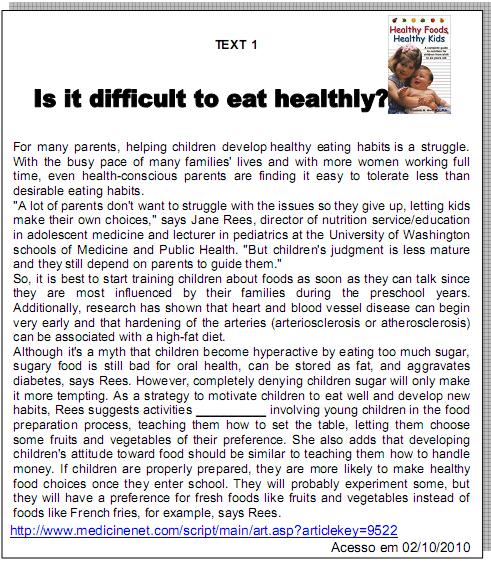
The correct expression to complete the sentence Rees suggests activities __________ involving young children in the food preparation process, teaching them how to set the table, letting them choose some fruits and vegetables of their preference. Is