Based on the text above, judge the following items.
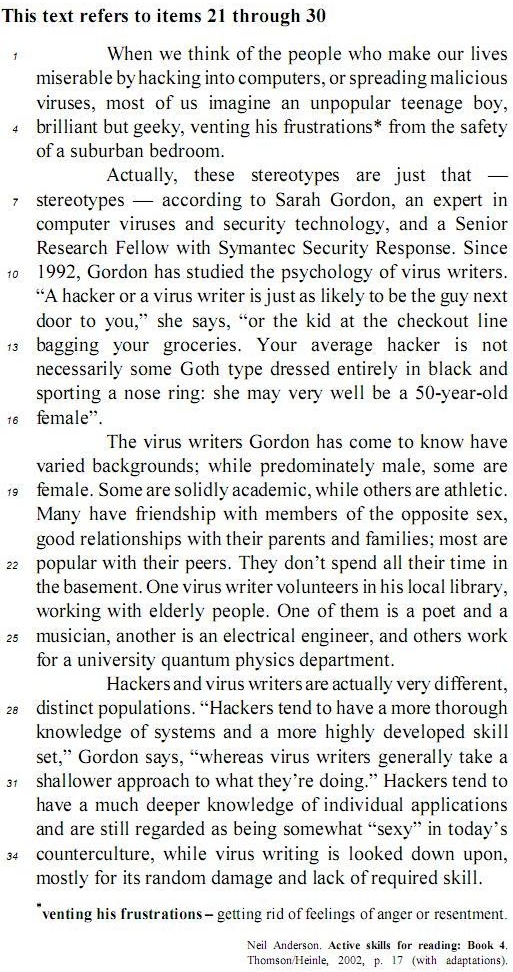
An average hacker would never be a female in her fifties.
An average hacker would never be a female in her fifties.
Selecione os filtros para encontrar suas questões de concursos e clique no botão abaixo para filtrar e resolver.
Nada por aqui
Considering translation and some of the notions it envolves, judge
the following items.
Context can be defined as extra-textual features which determine the translation of a linguistic expression or a whole text.
Considering translation and some of the notions it envolves, judge
the following items.
Acceptations which go beyond the primary meaning of a linguistic expression can be said to be connotative.
Considering linguistics aspects of English, judge the following
items.
There is an ambiguity in the following excerpt: The British Government makes little effort to tap European Community Funds for training women because they discriminate against men, according to the Department of Employment.
Considering translation and some of the notions it envolves, judge
the following items.
Concerning translation, faithfulness and adequacy can be used interchangeably as they both refer to the same translation strategy.
Judge the following item on translation and semiotics.
All texts can be analysed from a semiotic perspective.
Considering translation and some of the notions it envolves, judge
the following items.
Equivalence is a much debated term in translation studies for want of a widely accepted definition.
Considering translation and some of the notions it envolves, judge
the following items.
Formal correspondence is a concept which refers to the equivalence between the original text and the translated test in terms of register.
Considering linguistics aspects of English, judge the following
items.
The sentence The catching and eating of other animals is by no means the sole diet of a wild carnivore is inaccurate and has defects which might easily be carried over into a translation.
Read the dialogue.
A: So, I’ve decided that I’ll move to the big city to look for a dream job.
B: You know, that sounds like a good idea.
C: Well, actually you ought to make decisions about your future.
B: Right.
A: Anyway, I was wondering if either of you would help me find a furnished apartment to rent.
B: Look, I’m like...very busy during the week, I mean, I'm trying to catch up with my deadline.
C: I’m in the same boat.
A: What about the weekend? Say, Saturday afternoon? You both could take turns, and later we might grab some beers.
B: Fine with me!
C: Count me in!
The words reproducing pause, hesitation, redundancy, etc, present in the dialogue in abbreviated or full form are:
Analyse the sentences to indicate the ones with inconsistencies.
a. I can not agree to you in this situation.
b. Adriane had been marrried to Phil for so long when he died.
c. We’re just at the time to catch the train to Liverpool.
d. Sophia invests her money in the stock market.
e. Have you ever been to Singapore, Leonard?
f. Although he is a senior citizen, he can run very fast.
g. She is not only overweight but also lazy.
h. Megan apologized to Hugh for being so rude.
i. Our neighbor was charged with assault and battery.
j. Bela is so charming and beautiful as her sister but she is not a model.
l. Since he was deeply furious I said nothing.
m. Stop peering at my e-mails, that’s not your business!