Based on the text above, judge the following items
The bigger the project, the fewer people are demanded.
The bigger the project, the fewer people are demanded.
Selecione os filtros para encontrar suas questões de concursos e clique no botão abaixo para filtrar e resolver.
Nada por aqui
Leia o trecho abaixo e responda às questões de 36 a 40.
Life and the Movies
Joey Potter looked at her friend Dawson Leery and she smiled sadly.
"Life isn?t like a movie, Dawson," she said. "We can?t write happy endings to all our relationships."
Joey was a pretty girl with long brown hair. Both Joey and Dawson were nearly sixteen years old. The two teenagers had problems. All teenagers have the same problems – life, love, school work, and parents. It isn?t easy to become an adult.
Dawson loved movies. He had always loved movies. He took film classes in school. He made short movies himself. Dawson wanted to be a film director. His favorite director was Steven Spielberg. Dawson spent a lot of his free time filming with his video camera. He loved watching videos of great movies from the past. Most evenings, he watched movies with Joey.
"These days, Dawson always wants us to behave like people in movies," Joey thought. And life in the little seaside town of Capeside wasn?t like the movies.
Joey looked at the handsome, blond boy who was sitting next to her. She thought about the years of their long friendship. They were best friends...
According to the text, "The two teenagers had problems" because
A melhor tradução para Project 13.1.4 also aims to define the collaborative decision making processes needed by this new organisation of the network é:
Which alternative completes the sentence correctly?( Put the loaves in the (1) and bake them till they go brown.
Read the following sentences I, II, III:
I. I sent a letter to the airline company complaining about the problems I had during the flight and they have promised to look into the matter.
II. Although that doctor hasn’t won the Nobel Prize, I look up to him.
III. I promised her that I would look after her kids if she weren’t able to do that.
It’s correct to say that the meaning of each underline bold phrasal verb is respectively
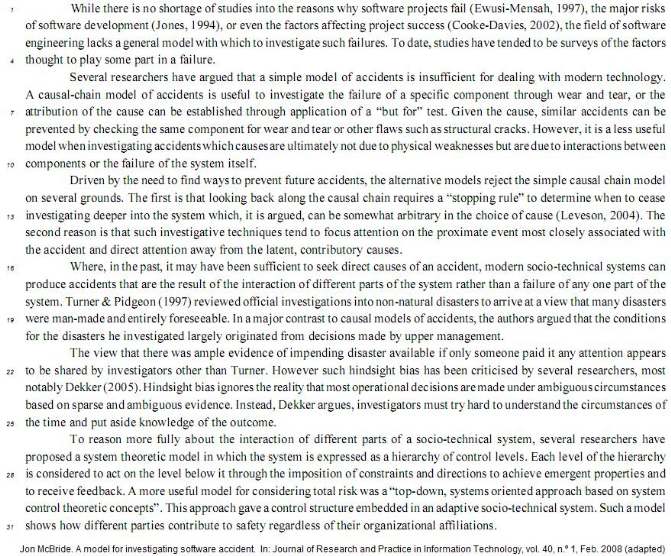
As Dekker has posed, investigators should focus on the circumstances of the time and disregard knowledge of the outcome.
As regards language teaching methods, judge the following items.
There is student-to-student interaction in drilling exercises or when students take different roles in dialogs, but this interaction is teacher-centered. Also, students are not allowed to initiate interaction. This describes the nature of student-student interaction in Suggestopedia.
As palavras bread, rice e spaghetti são substantivos incontáveis. Analise as frases abaixo e depois aponte o que elas têm em comum.
I. I only bought a loaf of bread.
II. She bought a kilogram of rice.
III. We need 450 grams of spaghetti for the recipe.
Considering Text II, write 1 for “iGeners” or 2 for “Millennials” to complete the following sentences.
( ) … can be referred to as ‘digital natives’.
( ) … were born between the early 1980s and 1990s.
( ) … dominate most social networking groups.
( ) … had to adapt quickly to a world undergoing rapid technological changes.
The correct sequence downwards is
The text below is part of the Japanese tale My Lord Bag of Rice:
Long, long ago there lived in Japan a brave warrior known to all as Tawara Toda or My Lord Bag of Rice. His true name was Fujiwara Hidesato and there is a very interesting story of how he came to change his name. One day he went out in search of adventures because he had the nature of a warrior and could not bear to be idle. So he picked up his two swords, took his huge bow, which was much taller than himself, in his hand, strapped his quiver on his back and started out.
He had not gone far when he came to the bridge of Seta-no-Karashi crossing one end of the beautiful Lake Biwa. As soon as he stepped on the bridge, he saw lying right across his path a huge serpent-dragon. Its body was so big that it looked like the trunk of a large pine tree and it took up the whole width of the bridge. One of its huge claws rested on the parapet of one side of the bridge while its tail lay right against the other. The monster seemed to be asleep, and as it breathed, fire and smoke came out of its nostrils.
At first, Hidesato could not help feeling alarmed at the sight of this horrible reptile lying in his path, for he must either turn back or walk right over its body.
In regard to sentence connection, decide about the correctness of the following statements.
“Mark’s friends don’t like Japanese food, and Mark doesn’t either” would still be correct if rewritten as Mark’s friends don’t like Japanese food, and so does he.
O texto a seguir é referência para as questões 73 a 76.
Lucy?s Big Brother Reveals New Facets of her Species
First came Lucy. Then came Lucy?s baby, an infant of her species. Now comes Lucy?s "big brother": the partial skeleton of a large male of Australopithecus afarensis, unveiled this week in the Proceedings of the National Academy of Sciences. The roughly 40% complete skeleton has been nicknamed Kadanuumuu, which means "big man" in the Afar language of the Afar Depression of Ethiopia, where it was found. "It was huge – a big man, with long legs", says lead author Yohannes Haile?Selassie, a palaeoanthropologist at the Cleveland Museum of Natural History in Ohio.
Dated to 3.6 million years ago, the new skeleton is almost half a million years older than Lucy and the second oldest skeleton found of a possible human ancestor. It had long legs and a torso and a pelvis more like those of a modern human than an African ape, showing that fully upright walking was in place at this early date, Haile?Selassie says. Although headless, the skeleton also preserves parts not found before in Lucy?s species. "It is important because it provides the ribs and scapula", says palaeoanthropologist Carol Ward of the University of Missouri, Columbia.
In 2005, a sharp?eyed member of Haile?Selassie?s team, Alemayehu Asfaw, spotted a fragment of lower arm bone on the ground at Woranso?Mille, about 48 kilometers north of Lucy?s grave at Hadar. Over the next 4 years, the team unearthed the shoulder blade, collarbone, ribs, and neck vertebra, the first time those bones were found together in an A. afarensis adult. The team also found a pelvis, an arm, and leg bones. Although they never found the skull or teeth, which are typically used to assign species, the skeleton?s age and similarity to Lucy suggest that it belongs to her species, says co?author Owen Lovejoy of Kent State University in Ohio.
The robust male stood between 1.5 and 1.7 meters tall, about 30% larger than Lucy. Isolated bones of other individuals suggest that some males were even larger, so the new skeleton doesn?t settle a long?standing debate over just how much sexual dimorphism there was in A. afarensis, Lovejoy says. The shoulder blade looks more like that of a gorilla and a modern human than that of a chimpanzee. The curvature of the second rib suggests a wide rib cage at the top and a barrel shape overall, similar to that of modern humans and distinct from the more funnel?shaped rib cage of a chimpanzee, the authors say.
(Science Magazine, 25 June 2010.)
Are the statements true (T) or false (F), according to the text?
( ) The new skeleton was really Lucy?s brother.
( ) The new skeleton is almost 100% complete.
( ) The new skeleton is larger than that of Lucy.
( ) The new skeleton is similar to a chimpanzee.
( ) The team spent four years excavating for bones.
Mark the alternative which presents the correct sequence, from top to bottom.
Read the text below to answer the question.
How octopuses taste things by touching
Octopus arms have minds of their own. Each of these eight supple yet powerful limbs can explore the seafloor in search of prey, snatching crabs from hiding spots without direction from the octopus brain. But how each arm can tell what its grasping has remained a mystery.
Now, researchers have identified specialized cells not seen in other animals that allow octopuses to taste with their arms. Embedded in the suckers, these cells enable the arms to do double duty of touch and taste by detecting chemicals produced by many aquatic creatures. This may help an arm quickly distinguish food from rocks or poisonous prey, Harvard University molecular biologist Nicholas Bellono and his colleagues report online October 29 in Cell.
The findings provide another clue about the unique evolutionary path octopuses have taken toward intelligence. Instead of being concentrated in the brain, two-thirds of the nerve cells in an octopus are distributed among the arms, allowing the flexible appendages to operate semiindependently.
(Adapted from: https://www.sciencenews.org/article/octopus-taste-touch-arm-suckers).