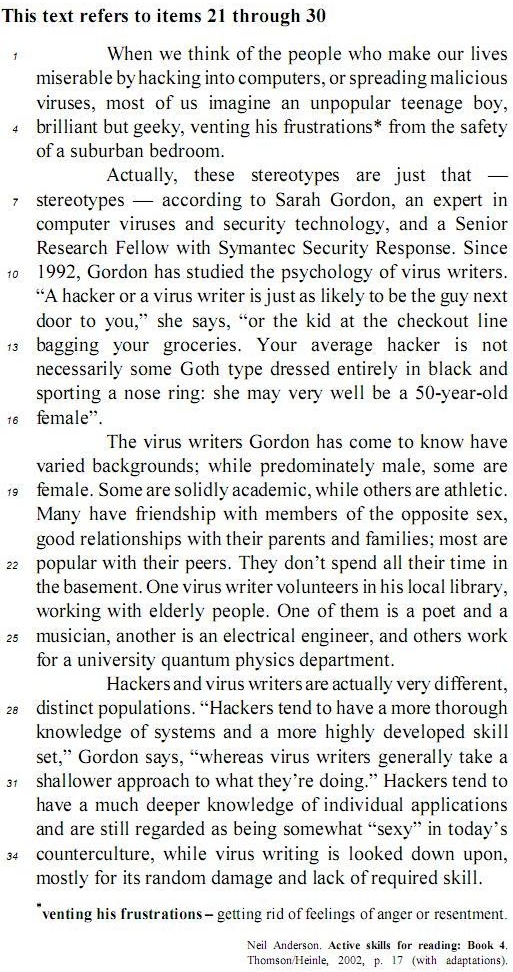
Based on the text above, judge the following items.
In the text,
“parents” ( .21) refers to mother and father.
In the text,
“parents” (
.21) refers to mother and father.Selecione os filtros para encontrar suas questões de concursos e clique no botão abaixo para filtrar e resolver.
Nada por aqui
.21) refers to mother and father.Julgue o item subsequente.
Pronouns, including personal pronouns like “he” and “she,”
replace nouns to avoid repetition. Understanding the
nuances of different pronoun types—personal,
demonstrative, relative—is essential for constructing clear
and concise sentences, contributing to effective
communication in English.
Research-Article
How to be a successful app developer: lessons from the simulation of an app ecosystem
Soo Ling Lim, Peter J. Bentley
Abstract
App developers are constantly competing against each other to win more downloads for their apps. With hundreds of thousands of apps in these online stores, what strategy should a developer use to be successful? Should they innovate, make many similar apps, optimize their own apps or just copy the apps of others? Looking more deeply, how does a complex app ecosystem perform when developers choose to use different strategies? This paper investigates these questions using AppEco, the first Artificial Life model of mobile application ecosystems. In AppEco, developer agents build and upload apps to the app store; user agents browse the store and download the apps. A distinguishing feature of AppEco is the explicit modelling of apps as artefacts. In this work we use AppEco to simulate Apple's iOS app ecosystem and investigate common developer strategies, evaluating them in terms of downloads received, app diversity, and adoption rate.
https://dl.acm.org/doi/10.1145/2384697.2384698
Julgue o item subsequente.
Countable and uncountable nouns present distinct
challenges in English grammar. Countable nouns refer to
individual items that can be enumerated, while
uncountable nouns denote substances or concepts
without clear boundaries. Mastery of these distinctions is
crucial for accurate article usage and grammatical
agreement.
Having analysed the words in the group, and taking into account words’ formation processes, there is correct data applicable to all of the group components in:
endanger- kilometre-outnumber-telescope-polyglot-misunderstood-prewar-
maltreat-photosynthesis-archbishop-deforestation-enable-rewind-absent
Considering the lexical-grammatical aspects of the English language, evaluate the following item.
The word "advice" is countable, so it's correct to say "an advice" when referring to a piece of advice.
Text I
The BNCC and Twenty-First Century Skills
The most ambitious feature of the BNCC, which only appeared in the document’s third version, was to establish ten core competencies that all students should develop throughout basic education, starting in early childhood. These competencies include lifelong learning, critical thinking, aesthetic sensibilities, communication skills, digital literacy, entrepreneurship, self-care, empathy, citizenship and ethics. The core competencies broaden the goals of basic education well-beyond academic skills to twenty-first century skills widely regarded as essential to preparing the next generations for the challenges of the 4th industrial revolution.
As ambitious as it was, the BNCC was criticized for the lack of explicit links between the ten core competencies and the subject specific competencies and skills, leaving cities and states with the responsibility of making these links themselves. In addition to this, the core competencies are not generally integrated into teacher training programs and are often de-prioritized for the more basic literacy and numeracy needs. In this context, the Ministry of Education and its partners in the third sector have developed orientations, produced videos and online courses aimed at filling this gap, and helped cities and states integrate the ten core competencies in their curricula.
[…]
Ensuring all Brazilian students master the ten core competencies laid out by the BNCC by the end of high school is a long-term, extremely ambitious goal. Before we can set a timeframe for when we will be able to achieve this feat, we need to know where we stand. Due to the core competencies’ complexity, each involves several skills, attitudes and sometimes values, it is unclear whether we will be capable of measuring all ten of them and by when. Until then we are in the company of the OECD, which is already tackling this challenge and will likely pave the way for Brazil in this respect
Note: BNCC: Base Nacional Comum Curricular;
OECD: The Organization for Economic Cooperation and Development.
Adapted from https://link.springer.com/chapter/10.1007/978-3-030-41882-3_2
Read the text to answer the question from.
It happens that the publication of this edition of the Oxford Advanced Learner’s Dictionary comes 250 years after the appearance of the first comprehensive dictionary of the English language, compiled by Samuel Johnson. Much has changed since then. The English that Johnson described in 1755 was relatively well defined, still essentially the national property of the British. Since then, it has dispersed and diversified, has been adopted and adapted as an international means of communication by communities all over the globe. English is now the name given to an immensely diverse variety of different usages. This obviously poses a problem of selection for the dictionary maker: which words are to be included in a dictionary, and thus granted recognition as more centrally or essentially English than the words that are left out?
Johnson did not have to deal with such diversity, but he too was exercised with this question. In his Plan of an English Dictionary, published in 1747, he considers which words it is proper to include in his dictionary; whether ‘terms of particular professions’, for example, were eligible, particularly since many of them had been derived from other languages. ‘Of such words,’ he says, ‘all are not equally to be considered as parts of our language, for some of them are naturalized and incorporated, but others still continue aliens...’. Which words are deemed to be sufficiently naturalized or incorporated to count as ‘parts of our language’, ‘real’ or proper English, and thus worthy of inclusion in a dictionary of the language, remains, of course, a controversial matter. Interestingly enough, even for Johnson the status of a word in the language was not the only, nor indeed the most important consideration. For being alien did not itself disqualify words from inclusion; in a remark which has considerable current resonance he adds: ‘some seem necessary to be retained, because the purchaser of the dictionary will expect to find them’. And, crucially, the expectations that people have of a dictionary are based on what they want to use it for. What Johnson says of his own dictionary would apply very aptly to The Oxford Advanced Learner’s Dictionary (OALD): ‘The value of a work must be estimated by its use: It is not enough that a dictionary delights the critic, unless at the same time it instructs the learner...’.
(Widdowson, H. Hornby, A.S. 2010. Adaptado)
Julgue o item subsequente.
Collective nouns, like “team” or “family,” present a
challenge in determining whether to treat them as
singular or plural. The context and intended emphasis
guide the decision, reflecting the collective unit's unity or
the individuality of its members. Mastery of collective
noun usage refines language precision and clarity.
Julgue o item subsequente.
Nouns, as essential components of language, categorize
and name entities, encompassing both tangible and
abstract concepts. The proper understanding of noun
classifications—common, proper, concrete,
abstract—facilitates precise and effective communication,
as nouns serve as the foundation for constructing
meaningful sentences.
Julgue o item subsequente.
Irregular plural forms, such as “children” and “geese,”
deviate from standard rules for creating plurals in English.
Recognizing these irregularities is crucial for accurate
usage, as these unique forms contribute to the richness
and diversity of the language. Mastery of irregular plurals
enhances language proficiency and writing skills.
TEXT 1
Anxiety has kept 28% of UK children away from school
Many children in the UK are missing school because they feel too anxious, according to a new survey. Research by stem4, a mental health charity for young people, found that 28% of children aged between 12 and 18 had missed school in the last year because of anxiety. The charity is asking the government, the health service and schools to do more to help pupils with their mental health.
More than 1,000 young people were surveyed, and almost half said that they were suffering from a mental health difficulty. Experts say that the problems have gotten worse since the coronavirus pandemic. At the moment, 38%of schools in England have a mental health support team. But the government has said that it wants to increase that to at least 50% by the end of March 2025, as well as training teachers and giving more money to the health service.
However, the survey also found that it is not only mental health that is keeping children away from school. Almost a quarter of children aged between 12 and 18 have missed school because of family problems, while 18% have stayed away because of problems with friends or other pupils. The stress of exams was also given as a reason for missing school.
Nihara Krause, the founder of stem4, said that spending a lot of time away from school can have long-lasting negative effects on children.
Adapted from: https://engoo.com.br/app/daily-news/article/anxiety-has-kept-28- of-uk-children-away-from-school/LY6CWsQ1Ee6_G7_OKvNYDg
Read the following instruction and then choose the correct answer.
Instruction: to answer the question below, consider the meaning of the words in italics in the context of Text I.
The sentence in which the word in italics is a countable noun is:
Julgue o item subsequente.
Subordinate clauses, also known as dependent clauses,
are introduced by subordinating conjunctions such as
“although,” “because,” or “while.” These clauses provide
additional information and cannot stand alone as
complete sentences. Proficiency in using subordinate
clauses enhances sentence complexity, enabling the
conveyance of intricate relationships and details in
American English.
Julgue o item subsequente.
Grammatical number distinguishes between singular and
plural forms of nouns, affecting both their morphology
and associated verbs. A nuanced understanding of
number agreement is essential for constructing
grammatically correct sentences, ensuring coherence and
precision in English communication.
Julgue o item a seguir.
In a noun phrase, the nucleus is always a noun or a noun
pronoun. Though it may contain modifiers, determiners,
adjectives, and other elements, the nucleus of the phrase
is the noun, which provides the main meaning of the
expression. Therefore, all noun phrases will have a noun
as their central element.