Atenção: As questões de números 47 a 70 referem-se a conhecimentos linguísticos da língua inglesa. Alberto ...... TV when the phone rang.
Questões de Concursos
selecione os filtros para encontrar suas questões de concursos e clique no botão abaixo para filtrar e resolver.
Publicidade
"The teacher stands outside a circle of students and helps them say what they want to say by translating, suggesting or amending the students utterances.
These utterances are recorded so that they can be analyzed later." This paragraph describes a lesson given according to the principles of:
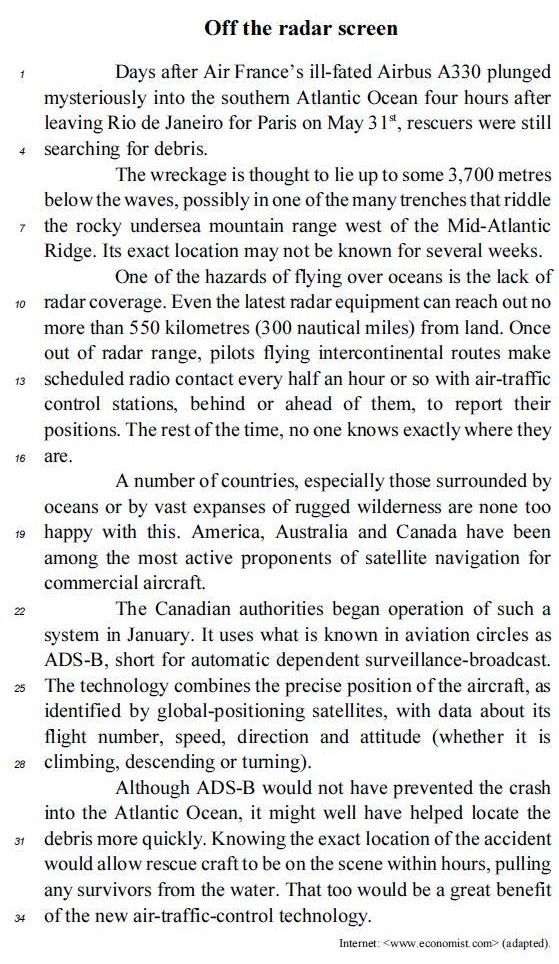
Judge the following items about the ideas and the linguistic structures
of the text above.
The automatic dependent surveillance broadcast would not have prevented the crash into the Atlantic, notwithstanding its technology which combines the precise position of the aircraft with data about its flight number, speed, direction as well as attitude.
Choose the correct sentence.
Dentre os fatores que influenciam a habilidade do ser humano em assimilar e usar línguas é INCORRETO destacar:
Exterior: Between The Museums — Day
CELINE
Americans always think Europe is perfect. But such beauty and history can be really oppressive. It reduces the individual to nothing. It just reminds you all the time you are just a little speck in a long history, where in América you feel like you could be making history. Thats why I like Los Angeles because it is so...
JESSE
Ugly?
CELINE
No, I was going to say “neutral”. Its like looking at a blank canvas. I think people go to places like Venice on their honeymoon to make sure they are not going to fight for the first two weeks of their marriage because they’l I be too busy looking around at all the beautiful things. Thats what people call a romantic place — somewhere where the prettiness will contain your primary violent instinct. A real good honeymoon spot would be like somewhere in New Jersey.
KRIZAN, K.; LINKLATER, R. Before Sunrise: screenplay.
New York: Vintage Books, 2005.
Considerando-se o olhar dos personagens, esse trecho do roteiro de um filme permite reconhecer que a avaliação sobre um lugar depende do(a)
TEXT
WHAT IS MODERN SLAVERY?
Slavery did not end with abolition in the 19th century. Slavery continues today and harms people in every country in the world.
Women forced into prostitution. People forced to work in agriculture, domestic work and factories. Children in sweatshops1 producing goods sold globally. Entire families forced to work for nothing to pay off generational debts. Girls forced to marry older men.
There are estimated 40.3 million people in modern slavery around the world, including:
• 10 million children
• 24.9 million people in forced labour
• 15.4 million people in forced marriage
• 4.8 million people in forced sexual exploitation
Someone is in slavery if they are:
• forced to work – through coercion, or mental or physical threat;
• owned or controlled by an ’employer’, through mental or physical abuse or the threat of abuse;
• dehumanised, treated as a commodity or bought and sold as ‘property’;
• physically constrained or have restrictions placed on their freedom of movement.
Slavery has been a disgraceful aspect of human society for most of human history. However, Anti-Slavery International has refused to accept that this bloody status quo should be allowed to persist (Aidan McQuade, former director).
Forms of modern slavery
Purposes of exploitation2 can range from forced prostitution and forced labour to forced marriage and forced organ removal. Here are the most common forms of modern slavery.
• Forced labour – any work or services which people are forced to do against their will3 under the threat of some form of punishment.
• Debt bondage or bonded labour – the world’s most widespread form of slavery, when people borrow money they cannot repay and are required to work to pay off the debt, then losing control over the conditions of both their employment and the debt.
• Human trafficking– involves transporting, recruiting or harbouring people for the purpose of exploitation, using violence, threats or coercion.
• Descent-based slavery – where people are born into slavery because their ancestors were captured and enslaved; they remain in slavery by descent.
• Child slavery – many people often confuse child slavery with child labour, but it is much worse. Whilst4 child labour is harmful for children and hinders5 their education and development, child slavery occurs when a child is exploited for someone else’s gain. It can include child trafficking, child soldiers, child marriage and child domestic slavery.
• Forced and early marriage – when someone is married against their will and cannot leave the marriage. Most child marriages can be considered slavery.
Many forms of slavery have more than one element listed above. For example, human trafficking often involves advance payment for travel and a job abroad, using money often borrowed from the traffickers. Then, the debt contributes to control of the victims. Once they arrive, victims cannot leave until they pay off their debt.
Many people think that slavery happens only overseas, in developing countries. In fact, no country is free from modern slavery, even Britain. The Government estimates that there are tens of thousands people in modern slavery in the UK.
Modern slavery can affect people of any age, gender or race. However, contrary to a common misconception6 that everyone can be a victim of
slavery, some groups of people are much more vulnerable to slavery than others.
People who live in poverty7 and have limited opportunities for decent work are more vulnerable to accepting deceptive job offers that can turn exploitative. People who are discriminated against on the basis of race, caste, or gender are also more likely to be enslaved. Slavery is also more likely to occur where the rule of law is weaker and corruption is rife. Anti-Slavery International believes that we have to tackle8 the root causes of slavery in order to end slavery for good. That’s why wepublished our Anti- Slavery Charter, listing comprehensive measures that need to be taken to end slavery across the world.
(Adapted from https://www.antislavery.org/slavery-today/modern-slavery/)
Glossary:
1. sweatshop – a factory where workers are paid very little and work many hours in very bad conditions
2. exploitation – abuse, manipulation
3. will – wish, desire
4. whilst – while
5. to hinder – obstruct, stop
6. misconception – wrong idea/ impression
7. poverty – the condition of being extremely poor
8. to tackle – attack
One of the statements below is according to the text. Mark it.
Intellectual Property
Industrial property legislation is part of the wider body of law known as intellectual property. Intellectual property relates to items of information or knowledge, which can be incorporated in tangible objects at the same time in an unlimited number of copies at different locations anywhere in the world. The property is not in those copies but in the information or knowledge reflected in them. Intellectual property rights are also characterized by certain limitations, such as limited duration in the case of copyright and patents.
The importance of protecting intellectual property was first recognized in the Paris Convention for the Protection of Industrial Property in 1883 and the Berne Convention for the Protection of Literary and Artistic Works in 1886. Both treaties are administered by the World Intellectual Property Organization (WIPO).
Countries generally have laws to protect intellectual property for two main reasons. One is to give statutory expression to the moral and economic rights of creators in their creations and to the rights of the public in accessing those creations. The second is to promote creativity and the dissemination and application of its results, and to encourage fair trade, which would contribute to economic and social development.
Intellectual property is usually divided into two branches, namely industrial property and copyright.
Copyright relates to artistic creations, such as poems, novels, music, paintings, and cinematographic works. The expression copyright refers to the main act which, in respect of literary and artistic creations, may be made only by the author or with his authorization.
The broad application of the term "industrial" is clearly set out in the Paris Convention for the Protection of Industrial Property (Article 1 (3)): "Industrial property shall be understood in the broadest sense and shall apply not only to industry and commerce proper, but likewise to agricultural and extractive industries and to all manufactured or natural products, for example, wines, grain, tobacco leaf, fruit, cattle, minerals, mineral waters, beer, flowers, and flour."
Industrial property takes a range of forms. These include patents to protect inventions; and industrial designs, which are aesthetic creations determining the appearance of industrial products. Industrial property also covers trademarks, service marks, layout-designs of integrated circuits, commercial names and designations, as well as geographical indications, and protection against unfair competition. In some of these, the aspect of intellectual creation, although existent, is less clearly defined. What counts here is that the object of industrial property typically consists of signs transmitting information, in particular to consumers, as regards products and services offered on the market. Protection is directed against unauthorized use of such signs likely to mislead consumers, and against misleading practices in general.
Understanding Industrial Property. World Intellectual Property Organization – WIPO,
p. 3-5. In: Internet: (adapted).
According to the text above, judge the following items.
"Intellectual property" is an umbrella term which defines a group of laws, including those concerning industrial property.
The complex linguistic universe of
Game of Thrones
1.Game of Thrones has garnered 38 Emmy
2.awards for its portrayal of a world of sex,
3.violence and politics so real that some viewers
4.could imagine moving there. Part of that detail
5.has been the creation of the richest linguistic
6.universe since J.R.R. Tolkien’s Middle Earth.
7.In the field of language-creation for fictional
8.worlds, there is Tolkien, and there is everybody
9.else. But David Peterson, the language-smith
10.of Game of Thrones , comes a close second for
11.the amount of thought put into its two
12.languages, Dothraki and Valyrian. The interest
13.in these tongues is such that a textbook for
14.learning Dothraki has been published, while
15.Duolingo, a popular online language-learning
16.platform, now offers a course in High Valyrian.
17.Inspired by fictional languages such as those
18.in the Star Wars films and with a master’s
19.degree in linguistics, Peterson made Dothraki
20.and Valyrian as rich and realistic as possible.
21.Creating words is the easy part; anyone can
22.string together nonsense syllables. But
23.Peterson, like Tolkien, took the trouble to give
24his words etymologies and cousins, so that
25.the word for “feud” is related to the words
26.“blood” and “fight”. To make the languages
27.pronounceable but clearly foreign, he put
28.non-English sounds in high-frequency words
29.(like khaleesi , or queen), put the stress in
30.typically non-English places, and had words
31.begin with combinations of sounds that are
32.impossible in English, like hr .
33.Armed with a knowledge of common linguistic
34.sound changes, he gives his languages the
35kinds of irregularities and disorder that arise in
36.the real world: High Valyrian’s obar
37(“curve”) becomes Astapori Valyrian’s uvor .
38.Words’ meanings—as in real life—drift, too,
39.giving the system more realistic messiness.
40.Languages also play a prominent role in the
41.storyline. Dothraki is the guttural language of
42.a horse-borne warrior nation, but high-born
43.Daenerys Targaryen does not look down on it;
44.methodically learning it is key to her rise.
45.Tyrion Lannister is left to administer the city
46.of Mereen despite his ropy command of
47.Valyrian, leading to some comic moments.
48.And a prophecy of a future hero acquires new
49.meaning when an interpreter explains that the
50.word in question is ambiguous in Valyrian—it
51.could be “prince” or “princess”.
52.It might seem odd that a highly sexist society
53.like the one of Game of Thrones would have
54.languages where sex roles were not clearly
55.marked, but languages are not always perfect
56.vehicles for a culture. Random change can
57.leave them with too many words for one
58.concept, and not enough for another. In this
59.way, the flawed nature of language reflects
60.the foibles of flawed humans and the
61.imperfect worlds they strive to create.
Adaptado de:
<="" span="" style="box-sizing: border-box;">
21725752-dothraki-and-valyrian-are-mostconvincing-
fictional-tongues-elvish>.
Acesso em: 21 nov. 2017.
Considere as possibilidades de reescrita do segmento methodically learning it is key to her rise (l. 44).
I - it is key to her rise methodically learning
II - to learn methodically is key to her rise
III- learning it methodically is key to her rise
Quais poderiam substituir o segmento destacado, sem prejuízo do sentido original e da correção gramatical?
Leia o texto para responder às questões de números 65 a 70.
What is organized crime?
Organized crime was characterised by the United Nations, in 1994, as: " group organization to commit crime; hierarchical links or personal relationships which permit leaders to control the group: violence, intimidation and corruption used to earn profits or control territories or markets; laundering of illicit proceeds both in furtherance of criminal activity and to infiltrate the legitimate economy; the potential for expansion into any new activities and beyond national borders; and cooperation with other organized transnational criminal groups." It is increasingly global. Although links between, for example, mafia groups in Italy and the USA have existed for decades, new and rapid means of communication have facilitated the development of international networks. Some build on shared linguistic or cultural ties, such as a network trafficking drugs and human organs, which links criminal gangs in Mozambique, Portugal, Brazil, Pakistan, Dubai and South Africa. Others bring together much less likely groups, such as those trafficking arms, drugs and people between South Africa, Nigeria, Pakistan and Russia, or those linking the Russian mafia with Colombian cocaine cartels or North American criminal gangs with the Japanese Yakuza. Trafficked commodities may pass from group to group along the supply chain; for instance heroin in Italy has traditionally been produced in Afghanistan, transported by Turks, distributed by Albanians, and sold by Italians. Organized crime exploits profit opportunities wherever they arise. Globalization of financial markets, with free movement of goods and capital, has facilitated smuggling of counterfeit goods (in part a reflection of the creation of global brands), internet fraud, and money-laundering. On the other hand, organized crime also takes advantage of the barriers to free movement of people across national borders and the laws against non-medicinal use of narcotics: accordingly it earns vast profits in smuggling migrants and psychoactive drugs. Briquet and Favarel have identified deregulation and the " rolling back of the state" in some countries as creating lacunae that have been occupied by profiteers. The political changes in Europe in the late 1980s fuelled the growth in criminal networks, often involving former law enforcement officers. Failed states, such as the Democratic Republic of Congo or Sierra Leone, have provided further opportunities as criminal gangs smuggle arms in and commodities out, for example diamonds, gold, and rare earth metals, often generating violence against those involved in the trade and in the surrounding communities. Finally, there are a few states, such as the Democratic Republic of Korea and Burma and Guinea-Bissau (once described as a narco-state) where politicians have been alleged to have played an active role in international crime. Organized criminal gangs have strong incentives. Compared with legitimate producers, they have lower costs of production due to the ability to disregard quality and safety standards, tax obligations, minimum wages or employee benefits. Once established, they may threaten or use violence to eliminate competitors, and can obtain favourable treatment by regulatory authorities either through bribes or threats.
(www.globalizationandhealth.com. Adaptado)
No trecho do segundo parágrafo Trafficked commodities may pass from group to group along the supply chain; for instance heroin in Italy has traditionally been produced in Afghanistan, transported by Turks, distributed by Albanians, and sold by Italians. a expressão for instance pode ser substituída, sem alteração de sentido, por
Leia o trecho abaixo e responda às questões de 31 a 35.
Mark ?uckerberg?s 650 Million Friends (and counting)
Back in June 2009, the globe?s potpourri of social–networking sites was extremely diverse: Google?s Orkut dominated India and Brazil; Central and South America preferred Hi5; Maktoob was king in the Arab world. The Vietnamese liked ?ing, the Czechs loved Lidé, South Koreans surfed Cyworld. Two years after that, and Facebook has stolen users away from its rivals very fast. It?s completely knocked Hi5 off the map in former strongholds such as Peru, Mexico, and Thailand. After a tense back–and–forth with Orkut in India, Facebook has emerged victorious. And it?s becoming more popular in Armenia, Georgia, and the Netherlands, where local providers are making a desperate last stand.
There are some glaring exceptions to Facebook?s colonization kick. Russians continue to use Vkontakte and Odnoklassniki, with Facebook a distant fourth in the rankings. China remains highly committed to domestic sites such as Qzone and Renren. But for the rest of us, we?re living in ?uckerberg?s world.
(endereço eletrônico omitido propositadamente)
According to the text, Facebook?s boom on the Internet was in
Choose the alternative that correctly completes the sentence below:
She speaks English with a (n)_________ American accent.
Read the text below and answer the question:
Circles - By Carl Sandburg
The White man drew a small circle in the sand and told the Red man “This is what the Indian knows” and drawing a big circle around the small one, “This is what the White man knows.” The Indian took the stick and drew an immense ring around both circles: “This is where the White man and the Red man know nothing”
Available at: https://quotationstreasury.wordpress.com Accessed on February, 20th 2021.
( )The White man thought the red man knew nothing. ( )The Red man´s answer showed he had more wisdom than the White man. ( ) The Native American is trying showing that the knowledge of both is tiny compared to the amount of things they do not know. ( ) It is pointless for a particular group of people to feel superior about their knowledge when compared to another group.
The correct order is:
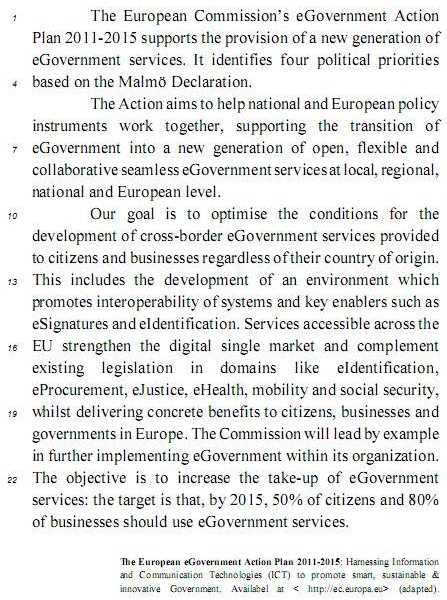
According to the text, the Action Plan 2011-2015
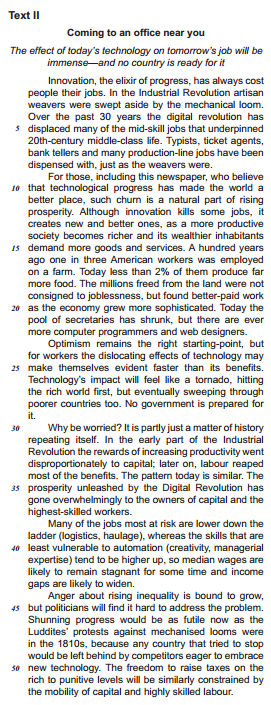
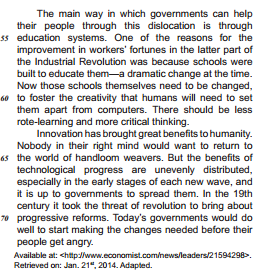
The boldfaced word in the fragments of Text II can be substituted, without change in meaning, by the word in italics in:
Analise as afirmativas relativas às competências e habilidades a serem desenvolvidas em Língua Estrangeira, segundo os Parâmetros Curriculares Nacionais:
I. Analisar recursos expressivos da linguagem verbal.
II. Distinguir variantes lingüísticas.
III. Utilizar uma abordagem instrumental da Língua Estrangeira.
IV. Compreender as diferentes manifestações da cultura corporal.
Está (ão) correta(s):
ADAPTACIÓN: LA CLAVE DE NUESTRA ESPECIE
Evolución quiere decir cambio a lo largo del tiempo. En esta definición se basó Charles Darwin para
escribir su famoso libro y desarrollar su idea sobre el origen de las especies. Una idea que parece que
ha tenido gran impacto en la forma de entender y estudiar el pasado de la vida en la Tierra. ¡Y vaya
que si tuvo impacto! La idea de evolución impregnó muchos campos del saber y permitió el estudio
del pasado del ser humano desde otra perspectiva.
Con el paso del tiempo se puede observar un cambio en los aspectos físicos del ser humano. Pero no
sólo se ha cambiado por fuera sino que el comportamiento del ser humano también ha protagonizado
cambios significativos a lo largo de la historia de su evolución.
Uno de los primeros pasos evolutivos hacia el humano moderno se le otorga al bipedismo. La
habilidad de caminar sobre las dos piernas empezó hace unos 4 millones de años. Desde entonces,
los cambios que se han producido en nuestra línea evolutiva han sido significativos. La introducción
de tecnología de piedra, el cambio en la dieta, la capacidad del lenguaje, etc. Y siempre con una
capacidad de adaptación sorprendente a nuevas formas de vida.
Si nos fijamos en la historia de la tecnología de piedra y en la de las telecomunicaciones centrándonos
en los teléfonos móviles, podemos observar un patrón común que se reproduce en ambas: la
tendencia a minimizar las dimensiones de las piezas y a hacerlas más finas. De verdaderos bloques
a objetos delicados y estilísticos.
La diferencia más notable entre una y otra tecnología es la rapidez del cambio entre diferentes
modelos. Mientras el desarrollo tecnológico de la piedra en los primeros seres humanos se prolongó
durante millones de años, en la era de las tecnologías tan solo se necesita poco más de una década
para evolucionar considerablemente.
Por tanto, pese a que lo más llamativo e impactante puede ser el cambio físico, el cambio de
comportamiento, el clima y evolución tecnológica quizás sean lo más determinante. Lo cual me
hace formularme la siguiente pregunta: ¿el cambio de comportamiento supuso el cambio físico
o fue al contrario? En cualquier caso, tanto un aspecto como el otro suponen evolución del ser
humano, y esto, hasta llegar hasta nuestros días, ha tenido muchos aspectos determinantes. Uno
de los más importantes sin lugar a dudas ha sido la inestabilidad climática que ha puesto a la
humanidad ante innumerables retos desde el inicio de la especie. Esto ha permitido desarrollar en
el género homo una capacidad abrumadora de adaptabilidad a los cambios del medio ambiente.
patrimoniointeligente.com
Current evidence suggests that these differences are not simply the result of recent acclimation (l. 19-20)
The underlined word above indicates that the author is cautious when he states that fact.
The sentence from the text that shows the same attitude on the author’s part is:
EBC•
Considering translation and some of the notions it envolves, judge the following items.
Acceptations which go beyond the primary meaning of a linguistic expression can be said to be connotative.
It can be gathered from text I that
human history may be based on material progress.
O ensino de língua inglesa na escola pública deve ter, dentre as várias funções, uma função social:
Publicidade