Mark the only alternative where the word ‘one’ functions as an indefinite personal pronoun.
Questões de Concursos
selecione os filtros para encontrar suas questões de concursos e clique no botão abaixo para filtrar e resolver.
Publicidade
One frequently overlooked area in planning is technical
reviews and inspections. A technical review requires substantial
preparation on the part of the presenters. Documents must be
published and distributed and presentation material organized and
made into slides or overheads. Practice sessions are conducted by
presenters with an audience of critics to prepare for the review.
The reviewers should read the material, attend the
presentations, and write reports. On large projects with many
reviews and walk-throughs involving many participants, a
substantial number of labor hours can be consumed analyzing
documents, attending meetings, and writing reports. For example,
a system design review for one module or unit can require 150
labor hours. When overlooked, this labor can result in a very
large error in resource and schedule estimation.
Many projects include risk assessment and risk
management as a key part of the planning process and expect the
plan toidentify specific risk areas. The plan is expected to
quantify both probability of failure and consequences of failure
and to describe what will be done to contain development risk.
A. Behforooz and F. Hudson. Software engineering
fundamentals. Ed. Oxford (adapted).
Based on the text above, judge the following items.
Some audiovisual materials are required for the presentation of issues to be dealt with.
They gave me a form and told me to _____________.

The adverb thereby (L.8) is synonymous with because of that.
Due to the pandemic they must be kept in isolation. A frase acima apresenta um marcador discursivo de:
Choose the correct alternative:
In the sentence
They give Anne a rather interesting book every single year., the verb give can be said to be a ditransitive verb.
Read the text below to answer questions 13–15.
Margarine vs. butter: are synthetic spreads toast?
Sales of margarine are in decline, due to a combination of reformulated recipes, price, health and taste. Do you defend margarine, or is butter simply better?
Butter vs. margarine: it?s a fight that has gone on for decades. On one side, there?s butter — rich, creamy, defiantly full–fat and made for millennia by churning the milk or cream from cattle. On the other, there?s margarine: the arriviste spread invented in the 1860s. It might not taste delicious, and it doesn?t sink into your toast like butter, but for decades margarine has ridden a wave of success as the "healthy" alternative.
No longer. Sales of margarine have plummeted in the last year, according to Kantar, with "health" spreads dropping 7.4% in sales. Flora has been particularly badly hit, losing £24m in sales, partly due to reformulating its recipe.
Meanwhile, butter is back in vogue. Brits bought 8.7% more blocks of butter last year, and 6% more spreadable tubs. This is partly due to the "narrowing price gap between butter and margarine", Tim Eales of IRI told The Grocer, but also to the home baking revival led by Mary Berry, Paul Hollywood and co. We?re all sticking unsalted butter in our sponges these days.
A yen for natural, unprocessed produce could also be a factor. "Since all the food scandals of the last 10 years, people are thinking about where their food comes from — butter is perceived as ?pure?", says food writer Signe Johansen. But is margarine really out for the count? Big brands are owned by powerful multinationals such as Unilever, with huge marketing budgets. Don?t rule spreads out just yet.
Margarine was invented in 1869 by a French food scientist, Hippolyte Mège–Mouriès, who responded to a challenge by Napoleon III. Napoleon wanted to find a long–life alternative to butter to feed troops in the Franco–Prussian war. Mège–Mouriès mixed skimmed milk, water and beef fat to create a substance similar to butter in texture, if not in taste. He called it "oleomargarine" after margarites, the Greek word for pearls — a reference to its pearly sheen. In 1871 he sold the patent to Jurgens, a Dutch firm now part of Unilever.
Beef fat was soon replaced by cheaper hydrogenated and non–hydrogenated vegetable oils. "Margarine gained a foothold during the first world war", says food writer and historian Bee Wilson. "George Orwell wrote of the ?great war? that what he remembered most was not all the deaths but all the margarine. But at this stage people recognized it was an inferior substitute for butter: an ersatz food, like drinking chicory instead of coffee."
In the second world war, British margarine brands were legally required to add vitamins to their recipes. "The move in status to margarine as a health food, marketing itself as a superior alternative, happened after the war", says Wilson. Added "healthy" extras — vitamins, omega–3s, unpronounceables that lower your cholesterol — are still a mainstay of the market.
But while margarine has spent decades fighting butter on the health front, what about taste? "Margarine has never been able to replicate the flavour of true butter", says Johansen. This despite the fact many brands add milk and cream to their spreads. "I Can?t Believe It?s Not Butter"? Really? I can.
Unsurprisingly, it?s hard to find a defendant of margarine among food writers and chefs. One of the few exceptions is Marguerite Patten, who is a fan of baking with Stork® . Indeed, Stork® does make for wonderfully crisp shortcrust pastry.
Margarine has taken a bashing on the health front in recent years, too. Negative press about trans fats in the 00s saw many brands remove hydrogenated fats from their spreads and reformulate their recipes. Growing suspicion of processed foods has led many consumers to return to butter. As Johansen puts it: "If you want a healthy heart, eat more vegetables."
And yet, and yet. I?m looking at a tub of Pure Dairy–Free Soya Spread. It contains 14g saturated fat per 100g, compared to butter?s 54%. For many consumers, such stats still outweigh taste when it comes to deciding what?s on their toast. And what about vegans, and those with lactose intolerance? Margarine can fulfill needs that butter can?t.
It will never win any taste awards, but there is still a place for margarine on the supermarket shelves — even if there isn?t one for it in most food lovers? fridges.
Margarine vs. butter: are synthetic spreads toast? Adapted. Available in:http://www.guardian.co.uk
Read the sentence below taken from the text and analyze the assertions below.
"Sales of margarine have plummeted in the last year, according to Kantar, with ?health? spreads dropping 7.4% in sales. Flora has been particularly badly hit, losing £24m in sales, partly due to reformulating its recipe."
I. The possessive pronoun "its" refers to Flora?s new recipe.
II. "Due to" establishes a relation of cause to the situation exposed.
III. "Badly" has the same gramar classification as "wooly".
The correct assertion(s) is(are)

The last sentece of the text “still, if you been running Windows without …” the word still could be replaced by … without altering its meaning.
Atenção: As questões de números 47 a 70 referem-se a conhecimentos linguísticos da língua inglesa.
Rafael: I didn?t like the football game.
Claudio: ......
Leia o texto, retirado do site www.java.net, para responder às
questões de números 59 e 60.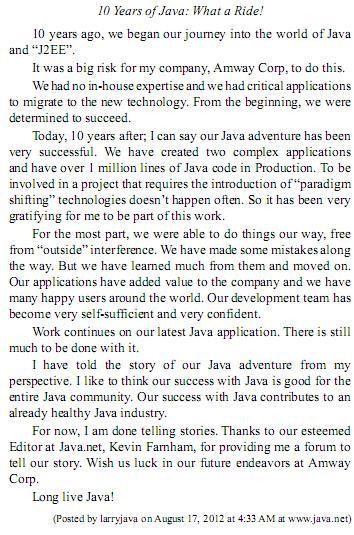
Segundo relato do autor, a equipe de desenvolvimento da Amway Corp tornou-se
A new computer worm masquerading as a software update from Microsoft Corp. is capable of deleting all files on the hard drive of an infected computer but has so far spread very slowly, an antivirus vendor said Monday. (CNN.com, Jan. 2002) According to the passage, the virus:
It’s a perilous time to be a statue. Not that it has ever
been a particularly secure occupation, exposed as statues are to
the elements, bird droppings and political winds.
Just ask Queen Victoria, whose rounded frame perches
atop hundreds of plinths across the Commonwealth, with an air
of solemn, severe solidity. But in 1963 in Quebec, members of a
separatist paramilitary group stuck dynamite under the dress of
her local statue. It exploded with a force so great that her head
was found 100 yards away.
Today, the head is on display in a museum,with her body
preserved in a room some miles away. The art historian Vincent
Giguère said that “the fact it’s damaged is what makes it so
important.”
There’s another reason to conserve the beheaded
Victoria. Statues of women, standing alone and demanding
attention in a public space, are extremely rare.
To be made a statue, a woman had to be a naked muse,
royalty or the mother of God. Or occasionally, an icon of war,
justice or virtue: Boadicea in her chariot in London, the Statue
of Liberty in New York.
Still, of 925 public statues in Britain, only 158 are women
standing on their own. Of those, 110 are allegorical or mythical,
and 29 are of Queen Victoria.
Julia Baird, The New York Times. September 4, 2017. Adaptado.
No texto, a figura da rainha Vitória é associada ao conceito de
Teaching English in the Brazilian countryside
“In Brazil, countryside youth want to learn about new places, new cultures and people. However, they think their everyday lives are an obstacle to that, because they imagine that country life has nothing to do with other parts of the world”, says Rafael Fonseca. Rafael teaches English in a language school in a cooperative coffee cultivation in Paraguaçu. His learners are the children of rural workers.
Rafael tells us that the objective of the project being developed in the cooperative is to give the young people more opportunities of growth in the countryside, and that includes the ability to communicate with international buyers. “In the future, our project may help overcome the lack of succession in countryside activities because, nowadays, rural workers’ children become lawyers, engineers, teachers, and sometimes even doctors, but those children very rarely want to have a profession related to rural work”, says Rafael.
“That happens”, he adds, “because their parents understand that life in the countryside can be hard work and they do not want to see their children running the same type of life that they have. Their children also believe that life in the country does not allow them to have contact with other parts of the world, meet other people and improve cultural bounds. The program intends to show them that by means of a second language they can travel, communicate with new people and learn about new cultures as a means of promoting and selling what they produce in the country, and that includes receiving visitors in their workplace from abroad.”
Rafael’s strategy is to contextualize the English language and keep learners up-to-date with what happens in the global market. “Integrating relevant topics about countryside living can be transformative in the classroom. The local regional and cultural aspects are a great source of inspiration and learning not only for the young, but for us all.”
Adapted from http://www.cambridge.org/elt/blog/2019/01/21/teaching-english-in-the-brazilian-classroom/
Choose the alternative with the correct reference for the underlined words from the text.
Read the sentence below.
The learner context is arguably the most critical factor for teachers to comprehend and the most secure foundation from which to launch their instruction. The underlined word can be replaced byLeia o texto para responder às questões:
The Right to a “Custody Hearing” under International Law
by Maria Laura Canineu
February 3, 2014
A person who is arrested has a right to be brought promptly before a judge. This is a longstanding and fundamental principle of international law, crucial for ensuring that the person’s arrest, treatment, and any ongoing detention are lawful.
Yet, until now, Brazil has not respected this right. Detainees often go months before seeing a judge. For instance, in São Paulo state, which houses 37 percent of Brazil’s total prison population, most detainees are not brought before a judge for at least three months. The risk of ill-treatment is often highest during the initial stages of detention, when police are questioning a suspect. The delay makes detainees more vulnerable to torture and other serious forms of mistreatment by abusive police officers.
In 2012, the UN Subcommittee on Prevention of Torture and Other Cruel, Inhuman or Degrading Treatment or Punishment reported that it had received “repeated and consistent accounts of torture and ill-treatment” in São Paulo and other Brazilian states, “committed by, in particular, the military and civil police.” The torture had allegedly occurred in police custody or at the moment of arrest, on the street, inside private homes, or in hidden outdoor areas, and was described as “gratuitous violence, as a form of punishment, to extract confessions, and as a means of extortion.”
In addition to violating the rights of detainees, these abusive practices make it more difficult for the police to establish the kind of public trust that is often crucial for effective crime control. These practices undermine legitimate efforts to promote public security and curb violent crime, and thus have a negative impact on Brazilian society as a whole.
The right to be brought before a judge without unnecessary delay is enshrined in treaties long ago ratified by Brazil, including the International Covenant on Civil and Political Rights (ICCPR) and the American Convention on Human Rights. The United Nations Human Rights Committee, which is responsible for interpreting the ICCPR, has determined that the delay between the arrest of an accused and the time before he is brought before a judicial authority “should not exceed a few days,” even during states of emergency.
Other countries in Latin America have incorporated this right into their domestic law. For instance, in Argentina, the federal Criminal Procedure Code requires that in cases of arrest without a judicial order, the detainee must be brought to a competent judicial authority within six hours.
In contrast, Brazil’s criminal procedure code requires that when an adult is arrested in flagrante and held in police custody, only the police files of the case need to be presented to the judge within 24 hours, not the actual detainee. Judges evaluate the legality of the arrest and make the decision about whether to order continued detention or other precautionary measures based solely on the written documents provided by the police.
The code establishes a maximum of 60 days for the first judicial hearing with the detainee, but does not explicitly say when this period begins. In practice, this often means that police in Brazil can keep people detained, with formal judicial authorization, for several months, without giving the detainee a chance to actually see a judge.
According to the code, the only circumstance in which police need to bring a person before the judge immediately applies to cases of crimes not subject to bail in which arresting officer was not able to exhibit the arrest order to the person arrested at the time of arrest. Otherwise, the detainee may also not see a judge for several months.
(www.hrw.org. Editado e adaptado)
No trecho do terceiro parágrafo – The torture had allegedly occurred in police custody… – o termo allegedly equivale, em português, a
Let’s keep the lights on when she’s your age. What sort of world will this little girl grow up in? Many experts agree that it will be a considerably more energyhungry one. There are already seven billion people on our planet. And the forecast is that there will be around two billion more by 2050. So if we’re going to keep the lights on for her, we will need to look at every possible energy source. At Shell we’re exploring a broad mix of energies. We’re making our fuels and lubricants more advanced and more efficient than before. With our partner in Brazil, we’re also producing ethanol, a biofuel made from renewable sugar cane. And we’re delivering natural gas to more countries than any other energy company. When used to generate electricity, natural gas emits around half the CO2 of coal. Let’s broaden the world’s energy mix. (Newsweek. June 25, 2012. Cover. Adapted.)
Read the text below to answer question 17–18.
Alzheimer?s disease
Alzheimer?s disease (AD) is a form of dementia, which is a brain disorder. It damages nerve cells in the brain. This affects your ability to remember things, think clearly, and care for yourself. AD begins slowly, and symptoms get worse with time. Eventually, a person with AD might need help in many areas, including eating and getting dressed. For some people in the early or middle stages of the disease, medicine might help symptoms, such as memory loss, from getting worse for a limited time. Other drugs may help people feel less worried or depressed. Dealing with Alzheimer?s disease can be extremely difficult, but planning ahead and getting support can lighten the load. AD usually begins after age 60, and risk goes up with age. The risk is also higher if a family member has had AD. Scientists are working to better understand AD. Ongoing studies are looking at whether some things can help prevent or delay the disease. Areas that are being explored include exercise, eating omega–3 fatty acids, and keeping your brain active. Alzheimer´s disease.
Available in: http://www.womenshealth.gov
Read the sentence below.
"Dealing with Alzheimer?s disease can be extremely difficult, but planning ahead and getting support can lighten the load."
It is correct to affirm that the underlined expression means that
Analise as afirmativas a seguir:
I. Em inglês, a frase to cut a lomg story short, possui um verbo reflexivo cujo significado principal é equivalente a reutilizar ou reformar. Assim, essa frase pode ser melhor traduzida como para reutilizar algo ou para reformar algo. II. O trecho a seguir, em inglês, está corretamente grafado: to keep to oneself (isolar-se dos outros espontaneamente).
Marque a alternativa CORRETA:
I. Em inglês, a frase to cut a lomg story short, possui um verbo reflexivo cujo significado principal é equivalente a reutilizar ou reformar. Assim, essa frase pode ser melhor traduzida como para reutilizar algo ou para reformar algo. II. O trecho a seguir, em inglês, está corretamente grafado: to keep to oneself (isolar-se dos outros espontaneamente).
Marque a alternativa CORRETA:
Atenção: As questões de números 47 a 70 referem-se a conhecimentos linguísticos da língua inglesa.
Sergio: What time is your class?
Danilo: ......
Publicidade