Questões de Concursos

selecione os filtros para encontrar suas questões de concursos e clique no botão abaixo para filtrar e resolver.

Publicidade

Imagem 006.jpg
Imagem 007.jpg
Imagem 008.jpg

According to Anna Nagurney, in paragraph 3 (lines 14-26), an efficient logistics system must consider the

NASA Researchers Studying Advanced Nuclear Rocket Technologies

January 9, 2013

By using an innovative test facility at NASA’s Marshall Space Flight Center in Huntsville, Ala., researchers are able to use non-nuclear materials to simulate nuclear thermal rocket fuels - ones capable of propelling bold new exploration missions to the Red Planet and beyond. The Nuclear Cryogenic Propulsion Stage team is tackling a three-year project to demonstrate the viability of nuclear propulsion system technologies. A nuclear rocket engine uses a nuclear reactor to heat hydrogen to very high temperatures, which expands through a nozzle to generate thrust. Nuclear rocket engines generate higher thrust and are more than twice as efficient as conventional chemical rocket engines.

The team recently used Marshall’s Nuclear Thermal Rocket Element Environmental Simulator, or NTREES, to perform realistic, non-nuclear testing of various materials for nuclear thermal rocket fuel elements. In an actual reactor, the fuel elements would contain uranium, but no radioactive materials are used during the NTREES tests. Among the fuel options are a graphite composite and a “cermet” composite - a blend of ceramics and metals. Both materials were investigated in previous NASA and U.S. Department of Energy research efforts.

Nuclear-powered rocket concepts are not new; the United States conducted studies and significant ground testing from 1955 to 1973 to determine the viability of nuclear propulsion systems, but ceased testing when plans for a crewed Mars mission were deferred.

The NTREES facility is designed to test fuel elements and materials in hot flowing hydrogen, reaching pressures up to 1,000 pounds per square inch and temperatures of nearly 5,000 degrees Fahrenheit - conditions that simulate space-based nuclear propulsion systems to provide baseline data critical to the research team.

“This is vital testing, helping us reduce risks and costs associated with advanced propulsion technologies and ensuring excellent performance and results as we progress toward further system development and testing,” said Mike Houts, project manager for nuclear systems at Marshall.

A first-generation nuclear cryogenic propulsion system could propel human explorers to Mars more efficiently than conventional spacecraft, reducing crews’ exposure to harmful space radiation and other effects of long-term space missions. It could also transport heavy cargo and science payloads. Further development and use of a first-generation nuclear system could also provide the foundation for developing extremely advanced propulsion technologies and systems in the future - ones that could take human crews even farther into the solar system.

Building on previous, successful research and using the NTREES facility, NASA can safely and thoroughly test simulated nuclear fuel elements of various sizes, providing important test data to support the design of a future Nuclear Cryogenic Propulsion Stage. A nuclear cryogenic upper stage - its liquid- hydrogen propellant chilled to super-cold temperatures for launch - would be designed to be safe during all mission phases and would not be started until the spacecraft had reached a safe orbit and was ready to begin its journey to a distant destination. Prior to startup in a safe orbit, the nuclear system would be cold, with no fission products generated from nuclear operations, and with radiation below significant levels.

“The information we gain using this test facility will permit engineers to design rugged, efficient fuel elements and nuclear propulsion systems,” said NASA researcher Bill Emrich, who manages the NTREES facility at Marshall. “It’s our hope that it will enable us to develop a reliable, cost-effective nuclear rocket engine in the not-too-distant future."

The Nuclear Cryogenic Propulsion Stage project is part of the Advanced Exploration Systems program, which is managed by NASA’s Human Exploration and Operations Mission Directorate and includes participation by the U.S. Department of Energy. The program, which focuses on crew safety and mission operations in deep space, seeks to pioneer new approaches for rapidly developing prototype systems, demonstrating key capabilities and validating operational concepts for future vehicle development and human missions beyond Earth orbit.

Marshall researchers are partnering on the project with NASA’s Glenn Research Center in Cleveland, Ohio; NASA’s Johnson Space Center in Houston; Idaho National Laboratory in Idaho Falls; Los Alamos National Laboratory in Los Alamos, N.M.; and Oak Ridge National Laboratory in Oak Ridge, Tenn.

The Marshall Center leads development of the Space Launch System for NASA. The Science & Technology Office at Marshall strives to apply advanced concepts and capabilities to the research, development and management of a broad spectrum of NASA programs, projects and activities that fall at the very intersection of science and exploration, where every discovery and achievement furthers scientific knowledge and understanding, and supports the agency’s ambitious mission to expand humanity’s reach across the solar system. The NTREES test facility is just one of numerous cutting-edge space propulsion and science research facilities housed in the state-of- the-art Propulsion Research & Development Laboratory at Marshall, contributing to development of the Space Launch System and a variety of other NASA programs and missions.

Available in: http://www.nasa.gov
Consider the verb tense in the following sentence taken from the text.

“Nuclear-powered rocket concepts are not new.”

Choose the alternative in which the extract is in the same verb tense as the one above.
Gracias a la vida
Gracias a la vida, que me ha dado tanto
Me dio dos luceros que cuando los abro
Perfecto distingo lo negro del blanco
Y en el alto cielo su fondo estrellado
Y en las multitudes el hombre que yo amo
Gracias a la vida, que me ha dado tanto
Me ha dado el sonido del abecedario
Con él las palabras que pienso y declaro
Madre amigo hermano
Y luz alumbrando la ruta del alma del que estoy amando
Gracias a la vida, que me ha dado tanto
Me ha dado la marcha de mis pies cansados
Con ellos anduve ciudades y charcos
Playas y desiertos, montañas y llanos
Y la casa tuya, tu calle y tu patio
Gracias a la vida, que me ha dado tanto
Me dio el corazón que agita su marco
Cuando miro el fruto del cerebro humano
Cuando miro el bueno tan lejos del malo
Cuando miro el fondo de tus ojos claros
Gracias a la vida, que me ha dado tanto
Me ha dado la risa y me ha dado el llanto
Así yo distingo dicha de quebranto
Los dos materiales que forman mi canto
Y el canto de ustedes que es el mismo canto
Y el canto de todos que es mi propio canto
Gracias a la vida, gracias a la vida
                                               VIOLETA PARRA
                                                    letras.mus.br

The song “Time” could be used to introduce the class “O tempo em nossas vidas” suggested in the text “Física
para poetas”.
The fragment of the lyrics that best relates to the class is:

Atenção: As questões de números 21 a 48 referem-se aos conhecimentos sobre formação de professores e ensino de língua inglesa.

O termo multiletramentos (multiliteracies) refere-se a

O texto a seguir é referência para as questões 77 a 80.

Germans make wonderful beer. Yet the productivity of the German beer industry is only 43 percent that of the U.S. beer industry. Meanwhile, the German metalworking and steel industries are equal in productivity to their American counterparts. Since the Germans are evidently capable of organizing industries well, why can?t they do so when it comes to beer?
It turns out that the German beer industry suffers from small?scale production. There are a thousand tiny beer companies in Germany, shielded from competition with one another because each German brewery has virtually a local monopoly, and they are also shielded from competition with imports. The United States has 67 major beer breweries, producing 23 billion liters of beer per year. All of Germany?s 1,000 breweries combined produce only half as much. Thus the average U.S. brewery produces 31 times more beer than the average German brewery.
This fact results from local tastes and German government policies. German beer drinkers are fiercely loyal to their local brand, so there are no national brands in Germany analogous to our Budweiser, Miller, or Coors. Instead, most German beer is consumed within 30 miles of the factory where it is brewed. Therefore, the German beer industry cannot profit from economies of scale. In the beer business, as in other businesses, production costs decrease greatly with scale. The bigger the refrigerating unit for making beer, and the longer the assembly line for filling bottles with beer, the lower the cost of manufacturing beer. Those tiny German beer companies are relatively inefficient. There?s no competition; there are just a thousand local monopolies.
The local beer loyalties of individual German drinkers are reinforced by German laws that make it hard for foreign beers to compete in the German market. The German government has so?called beer purity laws that specify exactly what can go into beer. Not surprisingly, those government purity specifications are based on what German breweries put into beer, and not what American, French, and Swedish breweries like to put into beer. Because of those laws, not much foreign beer gets exported to Germany, and because of inefficiency and high prices much less of that wonderful German beer than you would otherwise expect gets sold abroad. (Before you object that German Löwenbräu beer is widely available in the United States, please read the label on the next bottle of Löwenbräu that you drink here: it?s not produced in Germany but in North America, under license, in big factories with North American productivities and efficiencies of scal(E).

(Diamond, J. ,2005. Guns, Germs, and Steel. New York: Norton.)

Are the statements true (T) or false (F), according to the text?
( ) The United States produces less beer than Germany.
( ) The German steel industry is better organized than the German beer industry.
( ) The German metalworking industry is more productive than the American metalworking industry.
( ) In Germany there are more factories producing beer than in the United States.
( ) 43% of the beer sold in the United States is produced in Germany.

Mark the alternative which presents the correct sequence, from top to bottom.

Atenção: As questões de números 47 a 70 referem-se a conhecimentos linguísticos da língua inglesa.

Carlos: Can you tell me how to get to the cinema?

Policeman: ......

As far as the practice of language teaching is concerned, judge the items below. Discovery techniques encourage students to “discover” facts about grammar and grammatical usage on their own: teachers give students examples of language and ask them to find out how they work. This approach is more studentcentered.
                                            The cost of a cigarette
     
                A businesswoman’s desperate need for a cigarette on an
8-hour flight from American Airlines ________ in her being
arrested and handcuffed, after she was found lighting up in the
toilet of a Boeing 747, not once but twice. She ___________
because she _______ violent when the plane landed in England,
where the police subsequently arrested and handcuffed her. Joan
Norrish, aged 33, yesterday ________ the first person to be
prosecuted under new laws for smoking on board a plane, when
she was fined £440 at Uxbridge magistrates’ court.
                                            Adapted from Innovations , by Hugh Dellar and Darryl Hocking.
Choose the best alternative to complete the text using verbsin the Simple Past:

imagem-retificada-texto-001.jpg

Write True (T) or False (F).

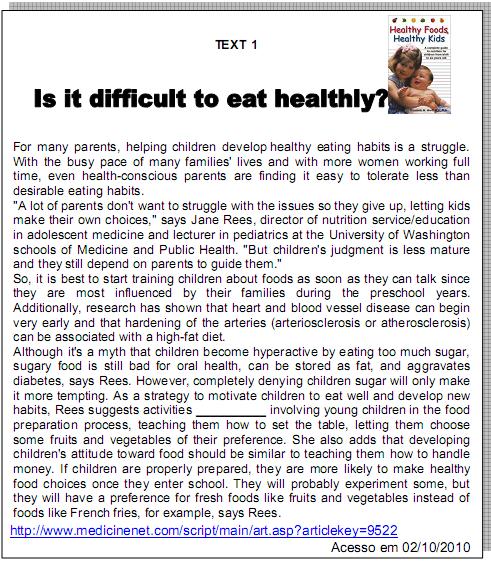
( ) Mothers tasks at home are easy because most of them work just part time.
( ) A lot of parents stop trying to teach children good healthy eating habits.
( ) It is better to teach children how to eat well when they are grown ups.

Which of the alternatives below completes the sentence correctly?
The receptionist allowed Mary into the concert hall (1)she was late.

Atenção: Considere o texto abaixo para responder às questões de números 51 a 60

Imagem 011.jpg
Imagem 012.jpg
Imagem 013.jpg

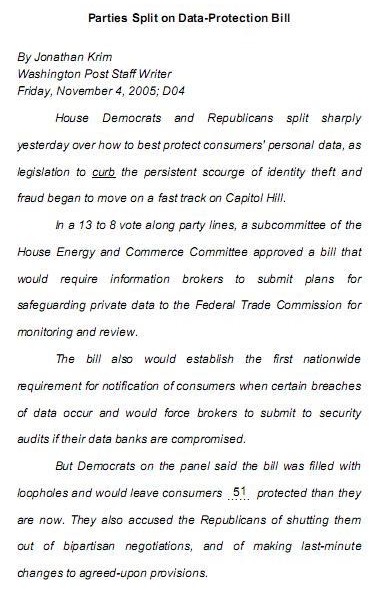
In the text, a synonym for curb (1st paragraph) is

TEXT
WHAT IS MODERN SLAVERY?
Slavery did not end with abolition in the 19th century. Slavery continues today and harms people in every country in the world.
Women forced into prostitution. People forced to work in agriculture, domestic work and factories. Children in sweatshops1 producing goods sold globally. Entire families forced to work for nothing to pay off generational debts. Girls forced to marry older men.
There are estimated 40.3 million people in modern slavery around the world, including:
• 10 million children
• 24.9 million people in forced labour
• 15.4 million people in forced marriage
• 4.8 million people in forced sexual exploitation
Someone is in slavery if they are:
• forced to work – through coercion, or mental or physical threat;
• owned or controlled by an ’employer’, through mental or physical abuse or the threat of abuse;
• dehumanised, treated as a commodity or bought and sold as ‘property’;
• physically constrained or have restrictions placed on their freedom of movement.
Slavery has been a disgraceful aspect of human society for most of human history. However, Anti-Slavery International has refused to accept that this bloody status quo should be allowed to persist (Aidan McQuade, former director).
Forms of modern slavery
Purposes of exploitation2 can range from forced prostitution and forced labour to forced marriage and forced organ removal. Here are the most common forms of modern slavery.
• Forced labour – any work or services which people are forced to do against their will3 under the threat of some form of punishment.
• Debt bondage or bonded labour – the world’s most widespread form of slavery, when people borrow money they cannot repay and are required to work to pay off the debt, then losing control over the conditions of both their employment and the debt.
• Human trafficking– involves transporting, recruiting or harbouring people for the purpose of exploitation, using violence, threats or coercion.
• Descent-based slavery – where people are born into slavery because their ancestors were captured and enslaved; they remain in slavery by descent.
• Child slavery – many people often confuse child slavery with child labour, but it is much worse. Whilst4 child labour is harmful for children and hinders5 their education and development, child slavery occurs when a child is exploited for someone else’s gain. It can include child trafficking, child soldiers, child marriage and child domestic slavery.
• Forced and early marriage – when someone is married against their will and cannot leave the marriage. Most child marriages can be considered slavery. 
Many forms of slavery have more than one element listed above. For example, human trafficking often involves advance payment for travel and a job abroad, using money often borrowed from the traffickers. Then, the debt contributes to control of the victims. Once they arrive, victims cannot leave until they pay off their debt.
Many people think that slavery happens only overseas, in developing countries. In fact, no country is free from modern slavery, even Britain. The Government estimates that there are tens of thousands people in modern slavery in the UK.
Modern slavery can affect people of any age, gender or race. However, contrary to a common misconception6 that everyone can be a victim of
slavery, some groups of people are much more vulnerable to slavery than others.
People who live in poverty7 and have limited opportunities for decent work are more vulnerable to accepting deceptive job offers that can turn exploitative. People who are discriminated against on the basis of race, caste, or gender are also more likely to be enslaved. Slavery is also more likely to occur where the rule of law is weaker and corruption is rife. Anti-Slavery International believes that we have to tackle8 the root causes of slavery in order to end slavery for good. That’s why wepublished our Anti- Slavery Charter, listing comprehensive measures that need to be taken to end slavery across the world.
(Adapted from https://www.antislavery.org/slavery-today/modern-slavery/)

Glossary:
1. sweatshop – a factory where workers are paid very little and work many hours in very bad conditions
2. exploitation – abuse, manipulation
3. will – wish, desire
4. whilst – while
5. to hinder – obstruct, stop
6. misconception – wrong idea/ impression
7. poverty – the condition of being extremely poor
8. to tackle – attack
Mark the INCORRECT statement according to the text.

Read text II and answer questions 37 to 40.

TEXT II


If you think that theres something oddly familiar about
descriptions of social media, it may be that you recall some of
the discussions in the 1990s about what the web would
become. And many of its emerging manifestations are close to
the idealistic imaginings from that time. A good way to think
about social media is that all of this is actually just about being
human beings. Sharing ideas, cooperating and collaborating to
create art, thinking and commerce, vigorous debate and
discourse, finding people who might be good friends, allies and
lovers its what our species has built several civilisations on.
Thats why it is spreading so quickly, not because its great
shiny, whizzy new technology, but because it lets us be
ourselves only more so. And it is in the more so that the
power of this revolution lies. People can find information,
inspiration, like-minded people,communities and collaborators
faster than ever before. New ideas, services, business models
and technologies emerge and evolve at dizzying speed in social
media.

(http://www.icrossing.co.uk/fileadmin/uploads}
/eBooks/What_is_social_media_Nov_2007.pdf

The expression like-minded people means people who

Imagem 003.jpg
Imagem 004.jpg

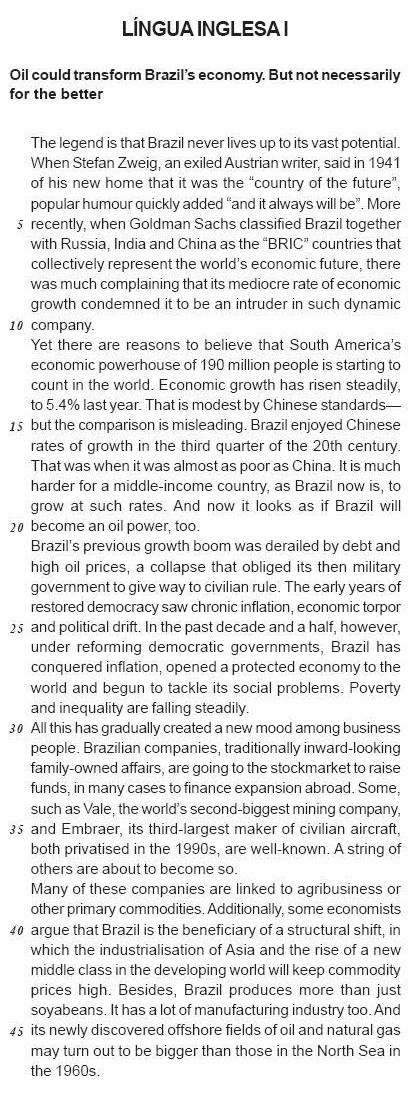
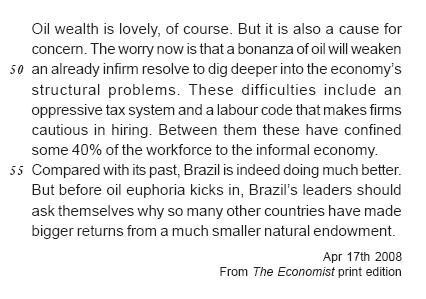
According to Paragraph 1 (lines 1-10), Brazil

O texto a seguir é referência para as questões 77 a 80.
School Curriculum Falls Short on Bigger Lessons
By Tara PARKER-POPE
Now that children are back in the classroom, are they really learning the lessons that will help them succeed?
Many child development experts worry that the answer may be no. They say the ever-growing emphasis on academic performance and test scores means many children aren?t developing life skills like self-control, motivation, focus and resilience, which are far better predictors of long-term success than high grades. And it may be distorting their and their parents? values.
In one set of studies, children who solved math puzzles were praised for their intelligence or for their hard work. The first group actually did worse on subsequent tests, or took an easy way out, shunning difficult problems. The research suggests that praise for a good effort encourages harder work, while children who are consistently told they are smart do not know what to do when confronted with a difficult problem or reading assignment.
Academic achievement can certainly help children succeed, and for parents there can be a fine line between praising effort and praising performance. Words need to be chosen carefully: Instead of saying, "I?m so proud you got an ?A? on your test", a better choice is "I?m so proud of you for studying so hard". Both replies rightly celebrate the ?A?, but the second focuses on the effort that produced it, encouraging the child to keep trying in the future.
Praise outside of academics matters, too. Instead of asking your child how many points she scored on the basketball court, say, "Tell me about the game. Did you have fun? Did you play hard?". Parents also need to teach their children that they do not have to be good at everything, and there is something to be learned when a child struggles or gets a poor grade despite studying hard. One strategy is to teach children that the differences between easy and difficult subjects can provide useful information about their goals and interests. Subjects they enjoy and excel in may become the focus of their careers. Challenging but interesting classes or sports can become hobbies.

(Adapted from www.nyt.com)

According to the text, how should parents react to their children?s performance?

imagem-retificada-texto-002.jpg

Write True (T) or False (F).

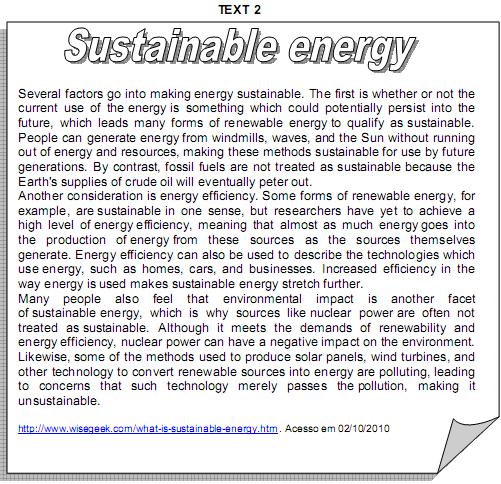
( ) The first paragraph states that there are both renewable forms of energy and forms that will gradually come to an end.
( ) The second paragraph analyses energy efficiency.
( ) The third paragraph considers nuclear power as the only form of environmental impact.

Considering translation and some of the notions it envolves, judge
the following items.

Concerning translation, faithfulness and adequacy can be used interchangeably as they both refer to the same translation strategy.

The complex linguistic universe of


Game of Thrones

1.Game of Thrones has garnered 38 Emmy

2.awards for its portrayal of a world of sex,

3.violence and politics so real that some viewers

4.could imagine moving there. Part of that detail

5.has been the creation of the richest linguistic

6.universe since J.R.R. Tolkien’s Middle Earth.

7.In the field of language-creation for fictional

8.worlds, there is Tolkien, and there is everybody

9.else. But David Peterson, the language-smith

10.of Game of Thrones , comes a close second for

11.the amount of thought put into its two

12.languages, Dothraki and Valyrian. The interest

13.in these tongues is such that a textbook for

14.learning Dothraki has been published, while

15.Duolingo, a popular online language-learning

16.platform, now offers a course in High Valyrian.

17.Inspired by fictional languages such as those

18.in the Star Wars films and with a master’s

19.degree in linguistics, Peterson made Dothraki

20.and Valyrian as rich and realistic as possible.

21.Creating words is the easy part; anyone can

22.string together nonsense syllables. But

23.Peterson, like Tolkien, took the trouble to give

24his words etymologies and cousins, so that

25.the word for “feud” is related to the words

26.“blood” and “fight”. To make the languages

27.pronounceable but clearly foreign, he put

28.non-English sounds in high-frequency words

29.(like khaleesi , or queen), put the stress in

30.typically non-English places, and had words

31.begin with combinations of sounds that are

32.impossible in English, like hr .

33.Armed with a knowledge of common linguistic

34.sound changes, he gives his languages the

35kinds of irregularities and disorder that arise in

36.the real world: High Valyrian’s obar

37(“curve”) becomes Astapori Valyrian’s uvor .

38.Words’ meanings—as in real life—drift, too,

39.giving the system more realistic messiness.

40.Languages also play a prominent role in the

41.storyline. Dothraki is the guttural language of

42.a horse-borne warrior nation, but high-born

43.Daenerys Targaryen does not look down on it;

44.methodically learning it is key to her rise.

45.Tyrion Lannister is left to administer the city

46.of Mereen despite his ropy command of

47.Valyrian, leading to some comic moments.

48.And a prophecy of a future hero acquires new

49.meaning when an interpreter explains that the

50.word in question is ambiguous in Valyrian—it

51.could be “prince” or “princess”.

52.It might seem odd that a highly sexist society

53.like the one of Game of Thrones would have

54.languages where sex roles were not clearly

55.marked, but languages are not always perfect

56.vehicles for a culture. Random change can

57.leave them with too many words for one

58.concept, and not enough for another. In this

59.way, the flawed nature of language reflects

60.the foibles of flawed humans and the

61.imperfect worlds they strive to create.

Adaptado de:

<="" span="" style="box-sizing: border-box;">

21725752-dothraki-and-valyrian-are-mostconvincing-

fictional-tongues-elvish>.

Acesso em: 21 nov. 2017.


Associe as palavras da coluna da esquerda aos seus respectivos sinônimos, na coluna da direita, de acordo com o sentido que têm no texto.


 ( ) garnered (l. 01)

 ( ) look down on (l. 43)

( ) ropy (l. 46)

 ( ) strive (l. 61)


 1. despise 

 2. earned 

 3. old-fashioned

 4. observe

 5. poor

 6. endeavor

 7. celebrated 

 8. aim

A sequência correta de preenchimento dos parênteses, de cima para baixo, é

Choose the alternative that correctly completes the text below using the verbs in brackets:

"William Shakespeare was born in April 1564 in the town of Stratford-upon- Avon, on England¡®s Avon River. When he _____ (to be) eighteen, he _____ (to marry) Anne Hathaway. The couple _____ (to have) three children¡ªtheir older daughter Susanna and the twins Judith and Hamnet. Hamnet, Shakespeare¡®s only son, _____ (to die) in childhood. Sometime between 1610 and 1613, Shakespeare is thought to _____ (to retire) from the stage and returned home to Stratford, where he died in 1616". (Disponivel em: ).

House Approves Higher Debt Limit Without Condition
By JONATHAN WEISMAN and ASHLEY PARKER
Feb. 11, 2014

WASHINGTON - Ending three years of brinkmanship in which the threat of a devastating default on the nation’s debt was used to wring conservative concessions from President Obama, the House on Tuesday voted to raise the government’s borrowing limit until March 2015, without any conditions.
The vote - 221 to 201 - relied almost entirely on Democrats in the Republican-controlled House to carry the measure and represented the first debt ceiling increase since 2009 that was not attached to other legislation. Only 28 Republicans voted yes, and only two Democrats voted no.
Simply by holding the vote, Speaker John A. Boehner of Ohio effectively ended a three-year Tea Party-inspired era of budget showdowns that had raised the threat of default and government shutdowns, rattled economic confidence and brought serious scrutiny from other nations questioning Washington’s ability to govern. In the process, though, Mr. Boehner also set off a series of reprisals from fellow Republican congressmen and outside groups that showcased the party’s deep internal divisions.
During the October 2013 government shutdown, The Times’s David Leonhardt explained the debt limit and how a failure to raise it could have affected the economy both at home and abroad.
"He gave the president exactly what he wanted, which is exactly what the Republican Party said we did not want,” said a Republican representative, Tim Huelskamp of Kansas, who last year unsuccessfully tried to rally enough support to derail Mr. Boehner’s re-election as speaker. “It’s going to really demoralize the base.”
The vote was a victory for President Obama, Democrats and those Senate Republicans who have argued that spending money for previously incurred obligations was essential for the financial standing of the federal government. “Tonight’s vote is a positive step in moving away from the political brinkmanship that’s a needless drag on our economy,” Jay Carney, the White House press secretary, said in a statement.
"A clean debt ceiling is a complete capitulation on the speaker’s part and demonstrates that he has lost the ability to lead the House of Representatives, let alone his own party,” said Jenny Beth Martin, co-founder of the Tea Party Patriots. “It is time for him to go.”
Senator Harry Reid of Nevada, the majority leader, commended the speaker and promised to pass the bill as soon as possible. “We’re happy to see the House is legislating the way they should have legislated for a long time,” he said.


(Adapted from http://www.nytimes.com/2014/02/12/us/politics/ boehner-to-bring-debt-ceiling-to-vote-without-policy- attachments. html?nl=todaysheadlines&emc=edit_th_2014021 2&_r=0)
De acordo com o texto,
Página 58
Publicidade